Gay Dating App Statistics 2026: What the Filings Actually Say
Grindr, Sniffies, SCRUFF and Tinder by the numbers. Who is growing, what people really pay, and why the user counts you see quoted aren't comparable.

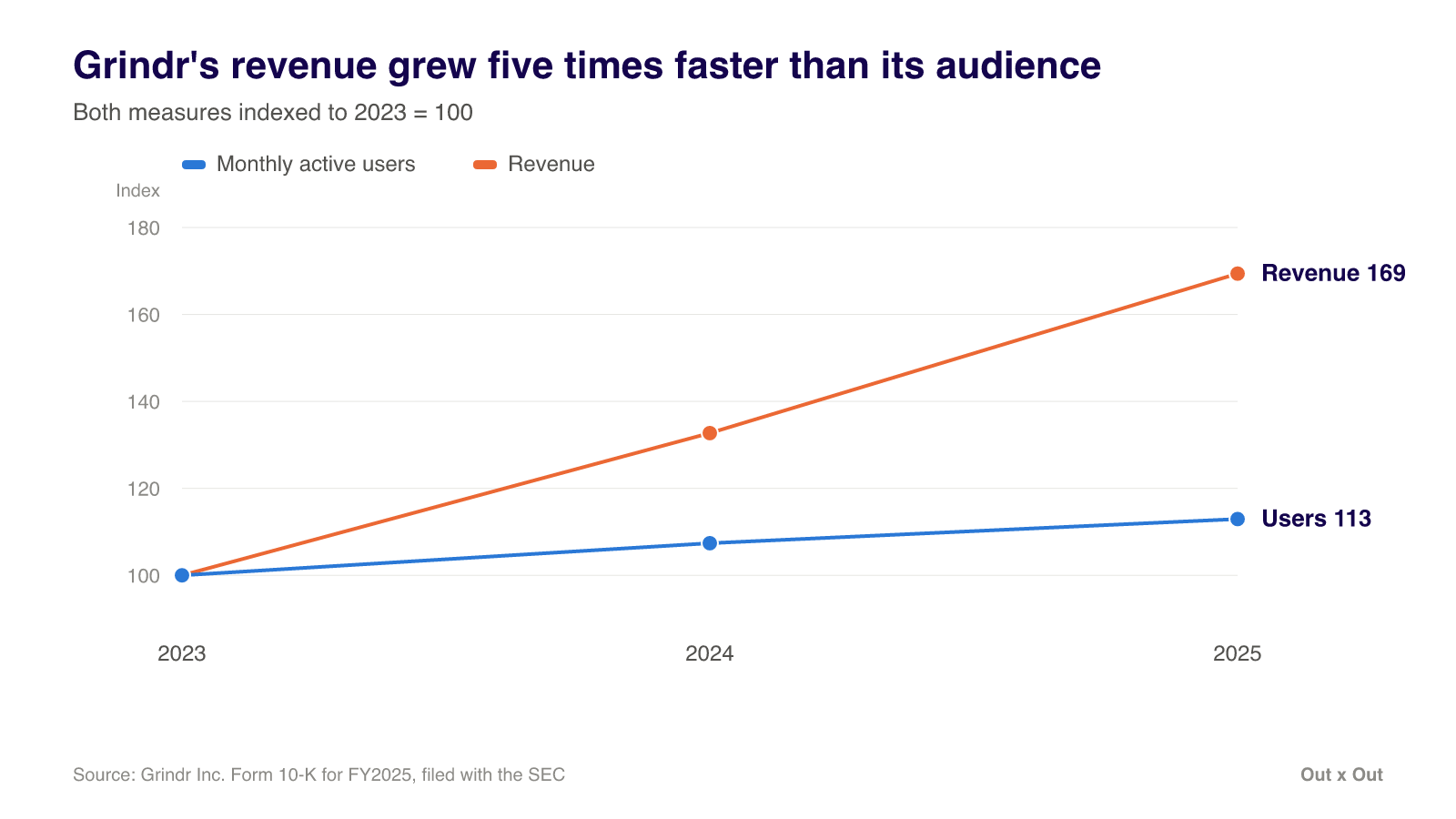
Go looking for how many people actually use the gay dating apps, and you hit a problem almost immediately: the numbers are not comparable.
Not slightly. Not in a way you can wave off. The headline figure each of these apps publishes is measured on a different basis from the one beside it, and stacking them in a table — which is what almost every "best gay dating apps" article does — produces something that looks like information and isn't.
So this is not a ranking. We are not going to tell you which app is best, because that is a question about you, not about the companies. What follows is the business underneath the apps, pulled from SEC filings, a regulator's decision and published survey work — with a note on where we fit at the end, since we make an app in this space too.
The key numbers at a glance
- Grindr: 14.99 million average monthly active users across 2025 — but that counts devices, not people (FY2025 Form 10-K)
- Grindr revenue: $439.9 million in 2025, up about 69% on 2023, on an audience up about 13%
- Sniffies: roughly 3 million monthly actives, on Match Group's own estimate — Match paid $100 million for a minority stake in April 2026
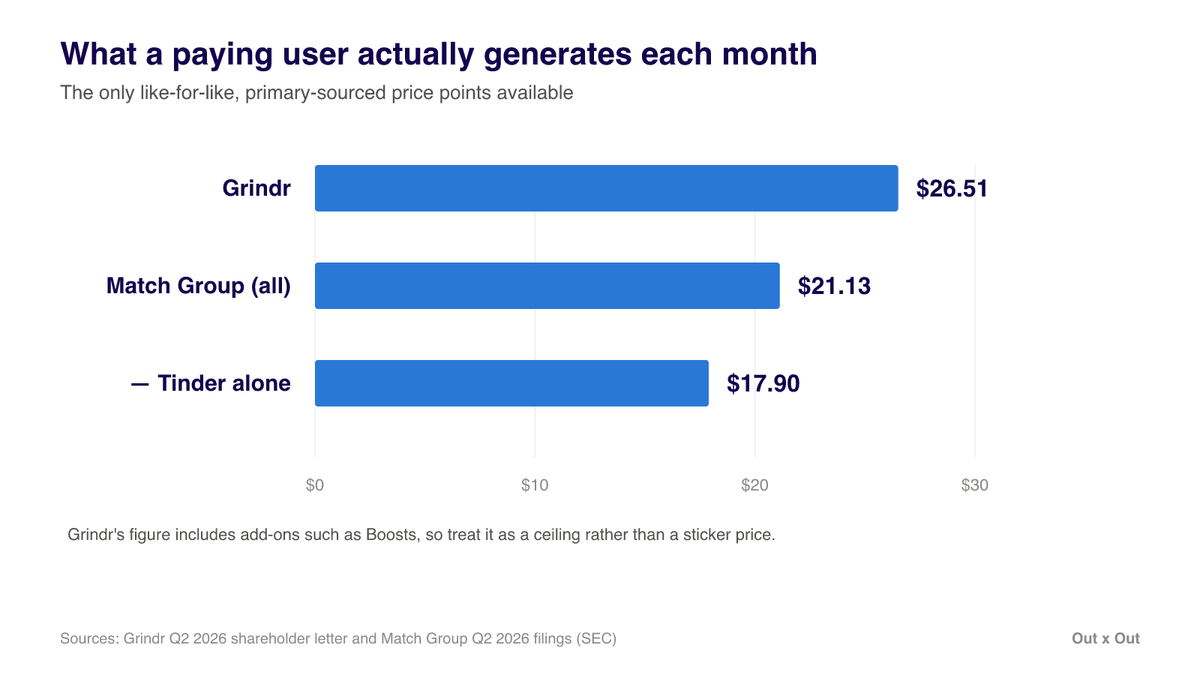
- Monthly spend per paying user, Q2 2026: Grindr $26.51 · Match Group $21.13 · Tinder $17.90
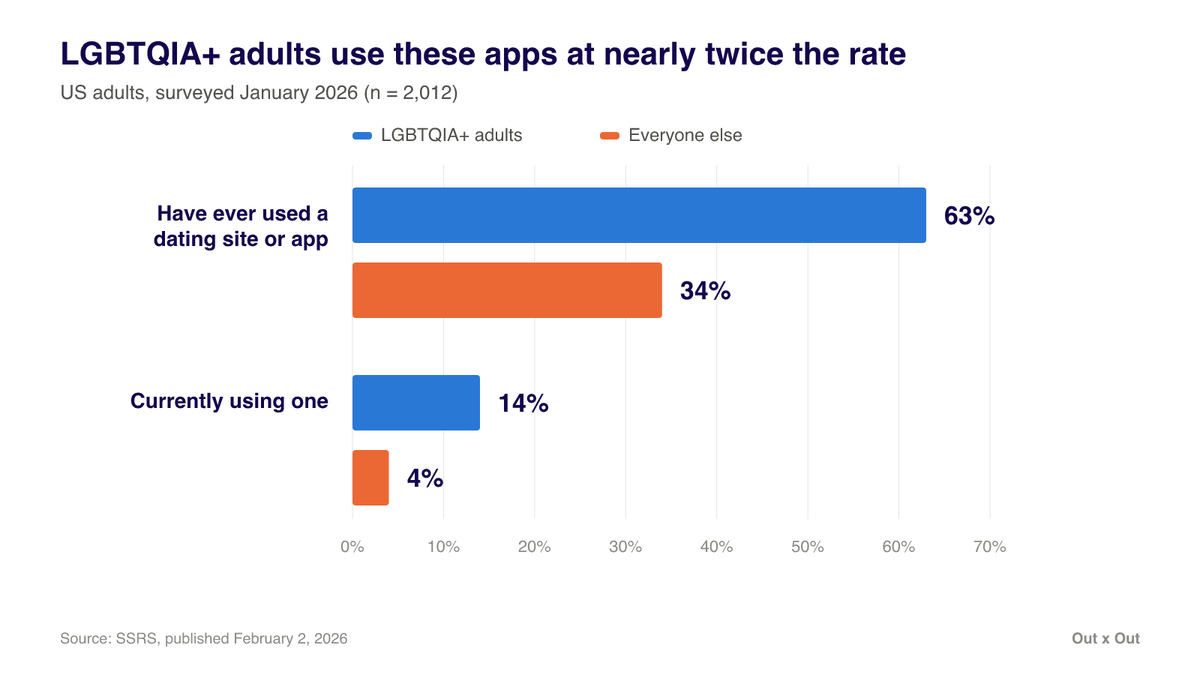
- Usage: 63% of LGBTQIA+ US adults have used a dating app, against 34% of everyone else (SSRS, January 2026)
How many users each gay dating app claims
Grindr reports 14.99 million average monthly active users for 2025. That figure comes from the company's annual report filed with the SEC, which is about as good as sourcing gets here — though it is still Grindr's own count, not an audited one, and it carries a definition most write-ups drop. Grindr counts a monthly active user as a unique device showing activity in a calendar month. Not a verified person. One man with a phone and a tablet is two.
Sniffies is described by Match Group as having "an estimated 3 million monthly active users globally" — note that Match hedged with estimated in its own announcement, which is unusual for an acquirer describing something it just paid for.
Hornet's App Store listing says it is "trusted by over 100 million gay, bi, trans, and queer men worldwide" — a claim with no stated basis, and certainly not a monthly one. Perry Street Software, which owns SCRUFF and Jack'd, publishes three different totals across its own web properties, so we are not going to pick one for them. Taimi has never published a monthly figure at all, and no established outlet has scrutinized the ones it does publish.
And no company here publishes an absolute daily active user number. Match reports which way Tinder's DAU is moving, but not the figure itself. So any article telling you which app people open most often is guessing.
Here is the whole problem in one table:
| App | Figure published | What it actually measures | Source |
|---|---|---|---|
| Grindr | 14.99 million | Average of twelve monthly counts of unique active devices | FY2025 Form 10-K (SEC) |
| Sniffies | ~3 million | Estimated monthly active users | Match Group announcement |
| Hornet | 100 million+ | Basis not stated; no monthly figure disclosed | App Store listing |
| SCRUFF + Jack'd | 30–45 million | Three different figures on their own pages | Perry Street Software |
| Taimi | 37 million+ | "Members"; no monthly figure ever disclosed | App Store listing |
The only two figures on anything close to a shared basis are Grindr's and Sniffies', and even those are devices against an estimate.
So if you want the blunt answer to which gay dating app has the most users: it is Grindr, on the only monthly-active basis that is comparable between any two apps here — with the caveat, which matters, that the figure counts devices rather than people.
What changed in 2026: Match's $100M Sniffies stake and Archer's shutdown
Two things, both in 2026, both documented.
Match Group put $100 million into Sniffies in April, taking what it called "a significant minority ownership stake" with an option to buy the rest. Match said Sniffies "will continue to operate independently and remain founder-led" — a statement of intent, not an outcome, and worth revisiting in a year. Sniffies is Seattle-based, launched in 2018, and is a browser-first product with a map: it lets people interact without making an account at all, which is a genuinely different model from everything else here. Weeks later Match shut down Archer, its own app aimed at gay, bi and queer men, launched back in 2023, as Attitude reported — it stopped building its own and bought into someone else's instead.
One wrinkle worth knowing about Sniffies, from its own numbers: the company says most of its users do not identify as gay. Its CMO put the gay share at 33% in early 2025, and its own year-end report claimed 42.3% bisexual or bi-curious and 25% straight or straight-curious. Both figures are self-reported and unaudited.
The market shrank for the first time — but not evenly. According to Business of Apps, global dating app revenue fell by close to 2% in 2025, to around $6 billion, with Tinder down 5.2% and Bumble down 9.5%. In the same year, it found, Grindr, PURE and Feeld all grew. Grindr's Q2 2026 revenue was $138.1 million, up 33% year over year.
The filings say the same thing in more detail. Match Group's Q2 2026 10-Q reports total Payers down 6% year over year to 13.25 million, with Tinder down 5% — and Hinge, in the same quarter, up 17%. Bumble's Q2 revenue fell 15.2% to $210.5 million and its paying users fell 16.4%. In its Q2 prepared remarks Match separately told investors that when Tinder's usage turns positive it will be the first time in more than three years.
So the honest headline is not that dating apps are dying. It is that mainstream apps are contracting while niche ones grow, and that even inside Match Group the money is moving between products rather than draining out of the category.
Grindr's revenue grew five times faster than its user base
This is the finding that surprised us most, and it is sitting in plain sight in Grindr's annual report.
Between 2023 and 2025, according to Grindr's FY2025 annual report, the company's average monthly actives went from 13.27 million to 14.99 million — roughly 13% over two years. Revenue over the same period went from $259.7 million to $439.9 million, about 69%. The gap is made up by squeezing more from the same people: paying-user penetration rose from 7.1% to 8.4%, and average revenue per paying user went from $20.05 to $24.25.
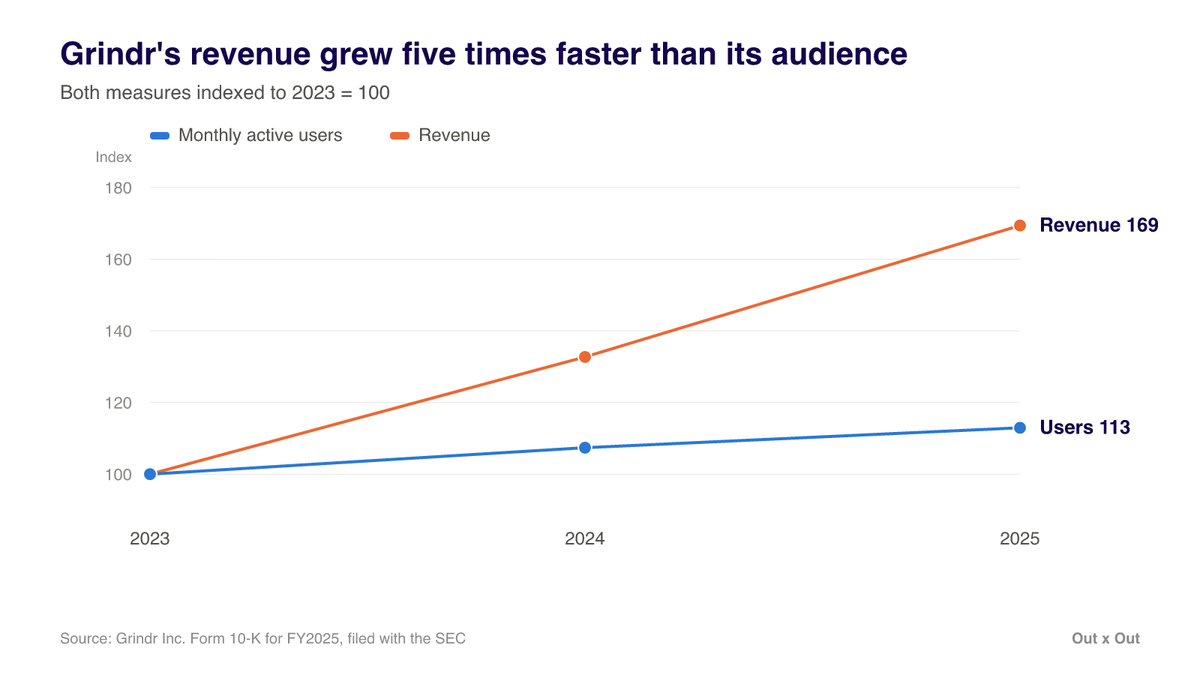
That is not a criticism, it is a business model. But it does mean the company's own growth now depends on converting and charging more of the same audience, which is worth knowing before you read any claim about how fast these apps are growing.
And it is not just Grindr. Match Group's revenue per payer rose 6% to $21.13 in Q2 2026 in the same quarter its payer count fell 6%. Two companies, opposite ends of the market, both filing the same shape of result: fewer or flatter users, more money extracted from each one. That is the clearest thing the filings say about this category right now.
Dating apps are pushing users toward meeting in person
Three companies, independently, in filings and interviews, saying much the same thing — and one conspicuously not.
Match is scaling in-person Events for Tinder — a Los Angeles pilot in March 2026 grew to more than 60 events, then nine more cities, with a stated plan to be in 26 cities before September is out, built "primarily around partnerships with leading event providers." Bumble's founder-CEO Whitney Wolfe Herd told investors the company is "expanding how they meet in real life, and building toward new group experiences." And Sniffies' CMO Eli Martin put it plainly to Metro Weekly: "We want to create a space for people to actually meet in real life."
Grindr is going the other way. Its own shareholder letter calls Right Now — its feature for immediate hookups — "one of the most important ways to strengthen Grindr's core hookup use case," and says the company is leaning into that rather than away from it. So this is not a whole-industry conversion.
We have an obvious interest in the in-person trend being real, which is exactly why we are pointing you at the primary sources rather than asserting it.
Privacy: the Grindr fine Norway's courts upheld
Almost every privacy claim in this category is a company describing itself. There is exactly one finding here that a regulator actually made and a court actually upheld.
Norway's data protection authority fined Grindr NOK 65 million — roughly $6.5 million — back in December 2021, for disclosing personal data, including special category data, to advertisers without a legal basis. Grindr appealed it up the chain and lost; the Borgarting Court of Appeal upheld the fine in October 2025, finding that Grindr lacked valid consent and that “data about the use of the app is special category personal data.” Grindr paid the principal in February 2026 and disputes an additional NOK 16.8 million in interest.
Grindr also faces a group action in the High Court in England and Wales on behalf of 10,041 users, with a second claim covering 1,964 more, alleging unlawful processing of personal data between 2009 and 2020. Those allegations are unproven. Grindr's own filing says it is "too early to determine the likely outcome."
Against that, Perry Street says it "has never shared or sold member lists with third-party data brokers," and that it pulled all third-party advertising from its apps in 2018 in response to GDPR, running ad programs in-house instead. We could not find an independent audit of that claim — but we also could not find any adverse regulator finding against Perry Street. Absence of a finding is not proof of the claim; it is still worth knowing.
For contrast on direction of travel: Grindr's advertising revenue grew 44% year over year to $25 million in Q2 2026 alone.
Gay dating app safety when you travel
This is where a comparison piece earns its keep, and where the reporting is strongest.
Apps get blocked and used against people. Malaysia cut off access to Grindr and Blued, along with other gay dating sites, in late February 2026. In Egypt, authorities use dating apps including Grindr to entrap and arrest people, with about 66 cases per year referred to trial since 2013 according to data from the group Bedayaa. Human Rights Watch logged 45 separate arrests, involving 40 LGBT people who had been targeted online across Egypt, Jordan, Lebanon and Tunisia, five of them ending in prison sentences of one to three years. That report is from February 2023, and we found nothing newer from HRW.
Worth saying clearly: entrapment is not a gay-app-only problem. Research by the free-expression group ARTICLE 19 names WhatsApp, Facebook Messenger, Instagram and Tinder alongside Grindr and Hornet.
Robbery and extortion appear to be badly undercounted. In July 2026 the FBI in South Florida warned of a rise in armed robberies of dating-app users, with gay men specifically targeted — that warning named no apps and gave no case counts, and we are not going to invent either. The clearest statement of the undercount problem came from a serving officer: after Kerala police broke up a four-man gang that used Grindr to lure, photograph and extort gay men, Inspector Azad Abdul Kalam said most victims never complained "because of the nature of the case, and also because of their social status."
One feature detail worth knowing. Grindr's own security guide says its PIN lock and Discreet App Icon — which disguises the app as something innocuous — were built for users in countries where being LGBTQ+ is most dangerous, and are free there. Everywhere else, they are bundled into paid XTRA and Unlimited. That guide dates from December 2022, so confirm current availability in the app.
While we are here: Grindr does not appear to have anything called a "Travel Mode." Traveler Alert was a Tinder feature, though we could not confirm it is still running — the last account of it we could stand up dates from 2020. The two get conflated constantly.
What gay dating apps cost: average spend per paying user
Be careful with app-store prices. Apple's in-app purchase panel does not show billing periods, so the same tier shows up at several numbers because these apps sell weekly, monthly, quarterly and annual terms. You cannot append "per month" to any of them, and we won't.
For scale, SCRUFF's in-app purchases ran from $3.99 to $119.99 on the US App Store in August 2026 — a range, not a monthly price, and that is exactly the problem. The defensible figure is what people actually spend. Grindr's average revenue per paying user was $26.51 a month in Q2 2026 — that includes add-ons like Boosts, so treat it as a ceiling on typical subscription spend rather than a sticker price. Match Group's comparable figure is $21.13 across all its brands, and $17.90 for Tinder on its own — Tinder being one of those brands, not a separate company.
Grindr has also been piloting an AI tier called EDGE at prices outlets have reported anywhere from about $80 a week to $500 a month. Those reports don't agree because they can't: Grindr says pilot pricing is "completely randomized across eligible users." Different people genuinely see different numbers.
Three gay dating app statistics that don't check out
Three figures circulate constantly in this category and none of them survive a check.
- "20% of Tinder matches are queer." Tinder's actual wording was "almost one in five matches in the markets the feature is available…" — and it is from 2020.
- "79% of Gen Z have dating app burnout." The variants run 78, 79 and 80 percent, attributed to different years, and the source page is unreachable. Methodology unknown.
- "19% of Bumble users are LGBTQ+." We could not find a primary source for this anywhere.
Relatedly: we could find no credible survey of dating-app fatigue among LGBTQ+ people specifically. If someone tells you gay men are burning out on apps, they are inferring it — reasonably, perhaps, from the business data above — not measuring it.
How many LGBTQ+ adults use dating apps
LGBTQ+ people use these platforms more than the general population, and that much is solid.
- 63% of LGBTQIA+ US adults have used a dating site or app, against 34% of everyone else — and 14% are currently using one, against 4%. That is SSRS, fielded January 2026 among 2,012 US adults.
- 51% of lesbian, gay and bisexual Americans had ever used one, against 28% of straight adults — Pew, but from July 2022 fieldwork, so treat it as historical.
- Among lesbian, gay and bisexual adults, men out-use women 57% to 46%, on that same Pew fieldwork.
- 62% of LGB men who had dated online had used Grindr. This is the only independent, non-company market-share figure we could find anywhere — and it is four years old.
Where we fit
Now the part we owe you. We are Out x Out, and we make an app in this market — a social-discovery and travel product rather than a dating one, but adjacent enough that you should read anything we say about competitors with the appropriate squint. That is why every number above is sourced to a filing, a regulator or published research rather than to our own opinion, and why we have flagged each place a figure comes from a company describing itself.
Out x Out is not competing for the hookup use case and we are not going to pretend otherwise — Grindr is explicit in its own investor materials that it is strengthening exactly that. We built a discovery product: bars, events, cities — the stuff you do once you are actually somewhere.
One last thing we noticed, and it is an observation rather than a finding. We read both of Match Group's Q2 2026 earnings documents end to end. The phrase "LGBTQ+" appears in them exactly once — in a line about extending a Tinder algorithm update to straight men and LGBTQ+ users. That is the sum of it, from the company that owns Tinder and Hinge and had just paid $100 million for a piece of a gay hookup app.
We should also name the competition honestly, because a piece like this is worthless otherwise: SCRUFF already does a version of what we do. Its Explore feature lists LGBTQ+ parties, prides and festivals worldwide and lets traveling members signal where they will be. We are not the only ones who spotted this.
What we would say, with the self-interest declared, is that the filings above describe a market taking discovery-by-swiping less for granted than it used to. It is worth being precise about the scale of that: Match calls its own Events push "a low-cost model built primarily around partnerships," not a heavy bet, and Grindr is doubling down on the grid. Make of it what you like. The filings are linked throughout so you can check every number yourself, which is the whole point of this piece.
Common questions
How many users does Grindr have? Grindr reported 14.99 million average monthly active users for 2025 in its FY2025 Form 10-K. A monthly active user is a unique device, not a verified person.
Is Sniffies owned by Match Group? Not outright. Match Group invested $100 million in April 2026 for what it called a significant minority stake, with an option to buy the rest. Match says Sniffies stays independent and founder-led.
What happened to Archer? Match Group invested in Sniffies in April 2026 and, weeks later, shut down Archer — its own app aimed at gay, bi and queer men, which it had launched back in 2023.
Does Grindr have a travel mode? We found no evidence of a feature by that name. Grindr does document a PIN lock and a Discreet App Icon. Traveler Alert was a Tinder feature, not Grindr's.
How much do people actually spend? In Q2 2026 the average paying Grindr user generated $26.51 a month, against $21.13 across Match Group's brands and $17.90 at Tinder. Grindr's figure includes add-ons like Boosts, so read it as a ceiling rather than a subscription price.
Are dating apps dying? No. Mainstream apps are shrinking while niche ones grow, and money is also moving between brands inside Match Group itself: Tinder's payers fell 5% in Q2 2026 while Hinge's, also a Match brand, rose 17%.
Stay in the Loop
LGBTQ+ travel tips & community updates
More news
 news
newsMiss North Carolina USA Lost Her Crown as Miss USA Condemned 'Racism, Homophobia, Transphobia'
Miss USA's chief executive named three categories of conduct and never specified what she had done. Two days later, Brittany Boltinhouse said she believes she lost the title over her politics and her faith.
 entertainment
Ryan Murphy's 'The Shards' Is Explicitly Gay, and Critics Are Divided on It
A closeted 17-year-old narrator, a serial killer and 1981 Los Angeles. Here is what is actually in it, and an honest account of a reception that runs from rave to write-off.
 travel
The Best US Cities for Gay Men Over 40
Forget the circuit-party rankings. Here's where gay life over 40 actually works — measured by community you can join, housing you can afford, and bars where you won't be the oldest guy in the room.
 culture
Why Do Gay Men Have a "Gay Voice"? It's Not the High Pitch — It's the S
Linguists have been measuring this since the 1960s. The high-voice half of the stereotype keeps failing to show up in the data. The S is a different story.