Every Pride Flag Explained: What the Colors Actually Mean

The rainbow flag has meant something specific since 1978 — one word per stripe, assigned by the man who dyed the first one. What every color means, why two stripes are gone, and all the other flags.
Get LGBTQ+ Travel Tips in Your Inbox
Join our newsletter for exclusive travel guides, local insights, and community updates. No spam, unsubscribe anytime.
Subscribe NowSomewhere between the parade route and the third bar of the afternoon, somebody hands you a flag you don't recognize. Six stripes you know. The one with the arrow on the side you sort of know. The one that's brown, orange, tan and a paw print — no idea.
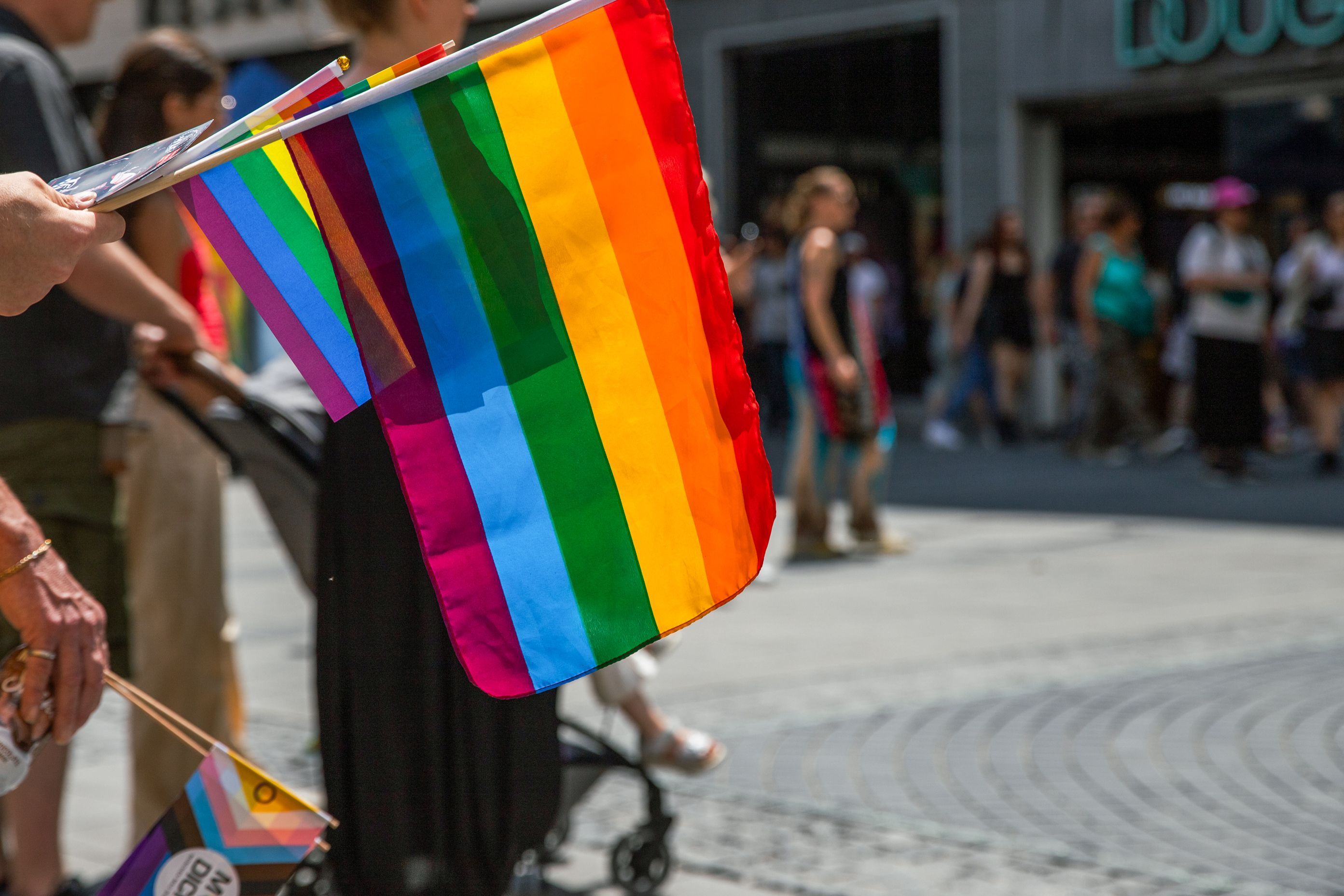
Here's what most explainers skip: the rainbow flag isn't a vague gesture at diversity. Gilbert Baker assigned one specific word to every stripe when he dyed the first one by hand in 1978, and those words are still the answer. Below is what each color means, why today's flag has two fewer stripes than the original, what the Progress flag adds, and a plain-language index of every other flag you'll see in the crowd.
The short answer
- What the rainbow flag represents: the LGBTQ+ community as a whole — and, stripe by stripe, life, healing, sunlight, nature, serenity and spirit
- Who made it: Gilbert Baker, a San Francisco artist and drag performer, first flown June 25, 1978
- Why a rainbow: Baker wanted a symbol pulled from nature rather than borrowed from a persecution history, broad enough to hold every kind of person under it
- Why it lost two stripes: hot pink fabric wasn't available in bulk, and turquoise was cut so the flag could split evenly across a lamppost
- Is the six-stripe version still correct: yes — as is the eight-stripe original, and the Progress version. None cancels the others out
What the Pride flag represents, and what each color means
The rainbow flag represents the LGBTQ+ community as a single, deliberately varied whole — and each stripe carries its own assigned meaning. Baker didn't pick colors because they looked good together. He picked six ideas and found colors for them.
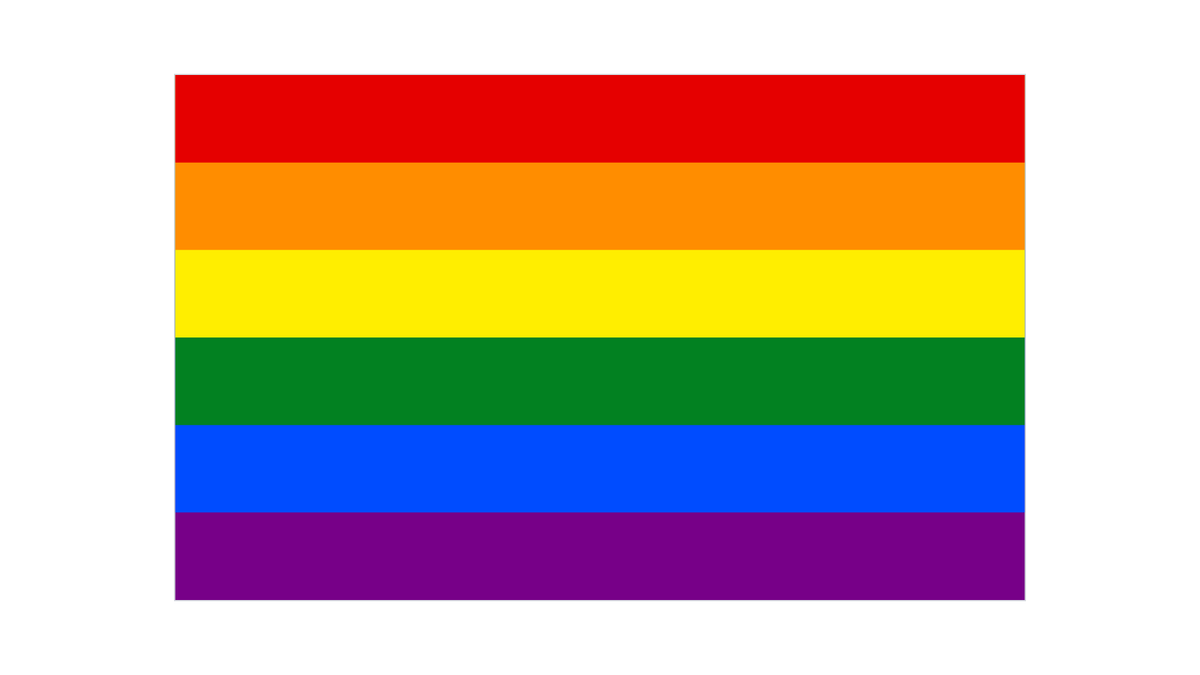
The six-stripe flag you see on porches, city halls and bar awnings, top to bottom:
- Red — life. Survival. The fact of being here.
- Orange — healing. Recovery and care, both individual and communal.
- Yellow — sunlight. Openness, visibility, being seen in daylight.
- Green — nature. Growth, and belonging to the natural world rather than standing outside it.
- Blue — serenity. Calm and dignity. This is the stripe that changed: Baker's original carried turquoise for magic and art plus indigo for serenity, and when turquoise was dropped, indigo was rendered as the royal blue you see today.
- Violet — spirit. The interior life. What survives.
Almost everyone flies it red-on-top, matching the order a rainbow appears in the sky. Worth knowing that's a convention, not a commandment — Baker himself is on record saying the flag has no right side up.
Pro Tip
Hanging one vertically on a wall or a pole? The convention is red on the left as the viewer faces it. Bar owners get this backwards constantly, and once you know it you can't unsee it.
Why is the Pride flag a rainbow?
Because the community needed a symbol that came from itself rather than from the people who had persecuted it. Before 1978, the emblem doing most of the work in gay political life was the pink triangle — a badge the Nazis used to mark gay men in concentration camps, reclaimed by activists in the 1970s. It carried real power, but it was inherited from an atrocity.
Baker's answer was the sky. He described the rainbow as fitting the community's diversity in race, gender and age better than any single symbol could — a natural thing, already understood everywhere, already meaning hope. By the Gilbert Baker Foundation's account, his friend Harvey Milk challenged him to come up with a symbol of pride; Baker, who had taught himself to sew, made a flag.
The first two went up on June 25, 1978, at San Francisco's Gay Freedom Day Parade, hand-dyed and stitched by Baker and a crew of volunteers in the attic of the Gay Community Center on Grove Street. He never trademarked the design — he considered it a gift to the community, and the fact that anyone can print it is why it went everywhere. The Museum of Modern Art added the flag to its design collection in June 2015. Baker died in March 2017.
Why pink and turquoise were removed
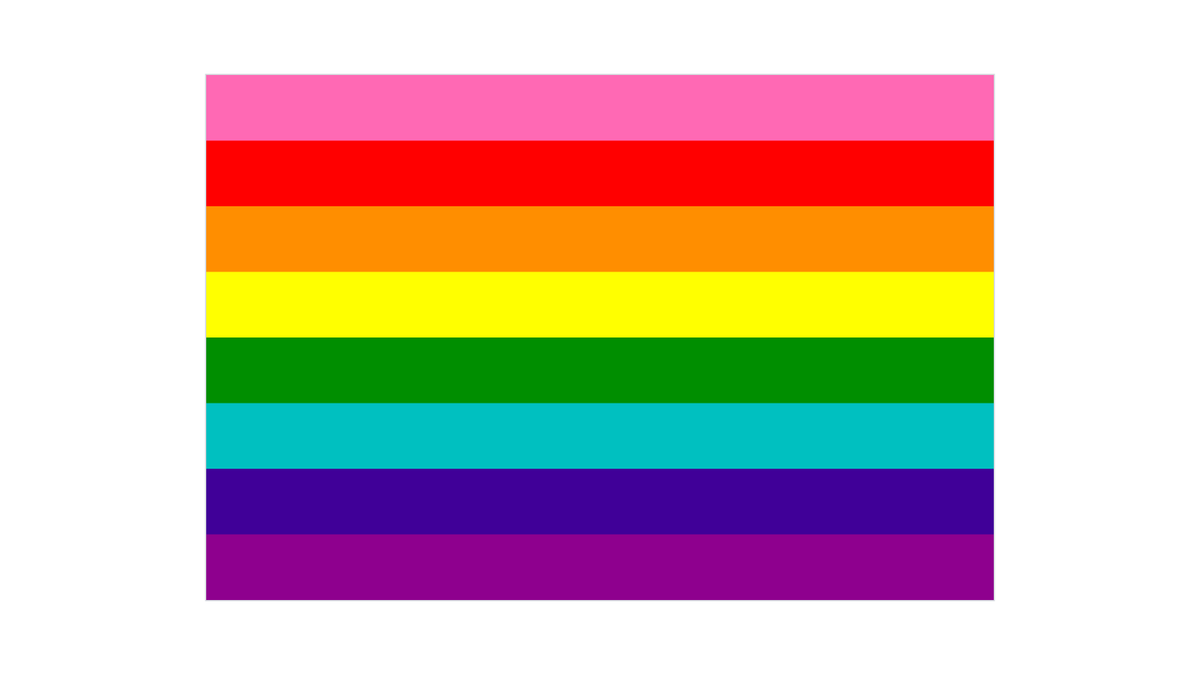
Both stripes came off for practical reasons, not political ones — which surprises people who assume something was taken away on purpose. They also came off at different moments, about a year apart.
The pink stripe: supply, late 1978. Harvey Milk was assassinated that November, five months after the flag's debut, and demand surged as the community rallied behind the symbol. Hot pink fabric wasn't available at commercial scale, so neither Baker nor the Paramount Flag Company could put it into mass production. The stripe came off, leaving seven.
The turquoise stripe: lampposts, 1979. For the 1979 parade, the flag was to run down Market Street with the design split down the middle, half hanging on each side of the lampposts. Seven stripes don't split evenly. Dropping turquoise left six — three and three — and that's the version the world adopted.
So the flag most people fly was shaped by a fabric shortage and some street furniture. That's how living symbols work. But it does mean the eight-stripe original — hot pink for sex, turquoise for magic and art — is the fuller statement of what Baker intended.
Is it still OK to fly the older flag versions?
Yes — genuinely, without an asterisk. The six-stripe rainbow flag is not retired, not outdated, and not a lesser choice. It's the default LGBTQ+ symbol worldwide, it's what most bars and Pride organizations still fly, and it says exactly what it has always said.
The same goes in the other direction. The eight-stripe 1978 flag turns up at Pride events and on bar walls as a nod to the original. Fly it. The seven-stripe version exists too, and if you've got one, it's a piece of the actual history.
What the newer flags do is add, not replace. Someone flying a Progress flag isn't correcting someone flying a rainbow flag — you'll see all of them within a block of each other on any Pride weekend. Fly the one that says what you mean.
What the Progress Pride flag adds
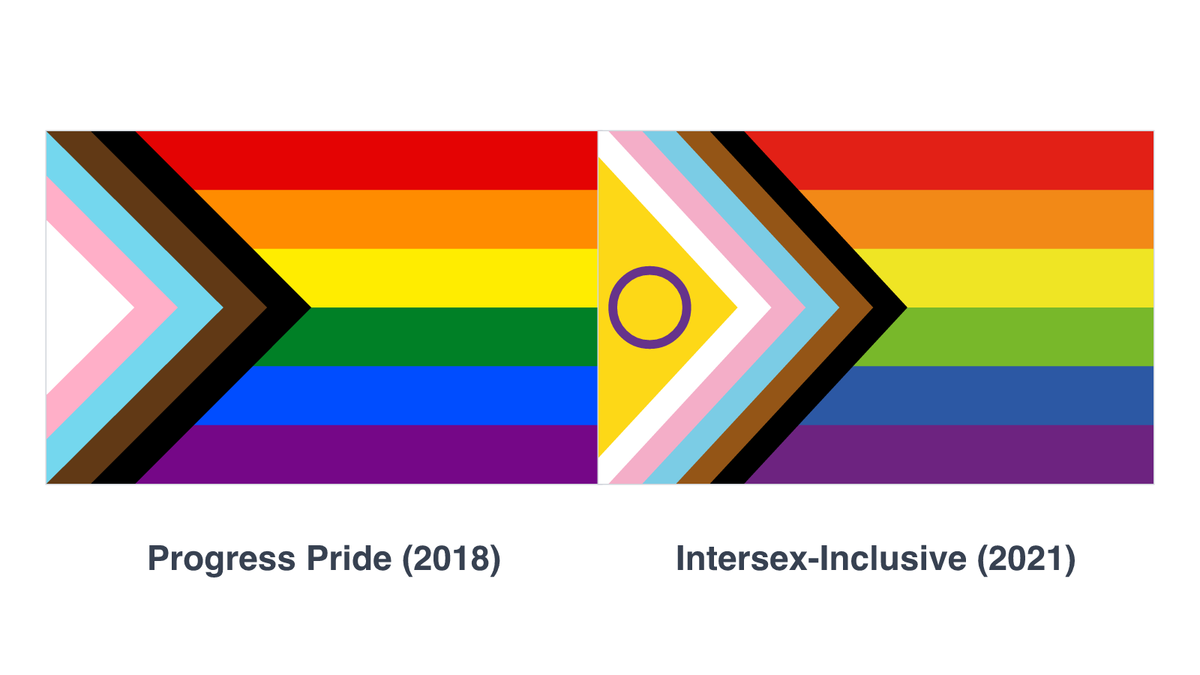
The Progress flag takes the six-stripe rainbow and adds a five-color chevron along the hoist — the left edge — pointing right. Daniel Quasar designed it in 2018, with a specific argument built into the geometry. The chevron holds two things:
- Black and brown, for LGBTQ+ people of color. These stripes trace to Philadelphia's More Color More Pride flag, launched by the city's Office of LGBT Affairs in June 2017 to confront racism within the community's own spaces. Quasar has also described the black stripe as carrying those living with HIV/AIDS, those lost to it, and the stigma around it.
- Light blue, pink and white, lifted straight from the transgender Pride flag.
The placement is the point. The chevron sits on the edge rather than in the field, and it points forward — Quasar's reasoning being that these groups' inclusion is still in motion, still something the community owes rather than something it has finished paying.
There's a further version: the Intersex-Inclusive Progress Pride flag, designed in 2021 by Valentino Vecchietti of Intersex Equality Rights UK, which adds a purple circle on a yellow triangle to the chevron — the elements of Morgan Carpenter's 2013 intersex flag. It has spread fast for a design this new; the Smithsonian's Cooper Hewitt flew it across the museum's facade for Pride in 2023.
When to use which
- The classic six-stripe rainbow. Anywhere the signal has to read instantly — venue windows, city flagpoles, merch, anything a stranger parses from across a street.
- The Progress flag. When the point is specifically about inclusion — an organization stating a position, an event centering trans and Black and brown attendees, a workplace putting something on the wall it intends to be held to.
- The eight-stripe original. History-forward contexts: anniversaries, archives, bars that trade on longevity.
Pro Tip
Venue or business choosing one flag for the door? Pick the one you can stand behind year-round. A Progress flag in June that comes down July 1 gets noticed and remembered — not warmly. A plain rainbow that stays up all year reads as more honest.
The Bear Brotherhood flag
The one with the paw print. Craig Byrnes designed the International Bear Brotherhood flag in 1995, out of a senior psychology project on bear culture, and it's now standard at bear runs, leather weekends and any bar with a Sunday beer bust.
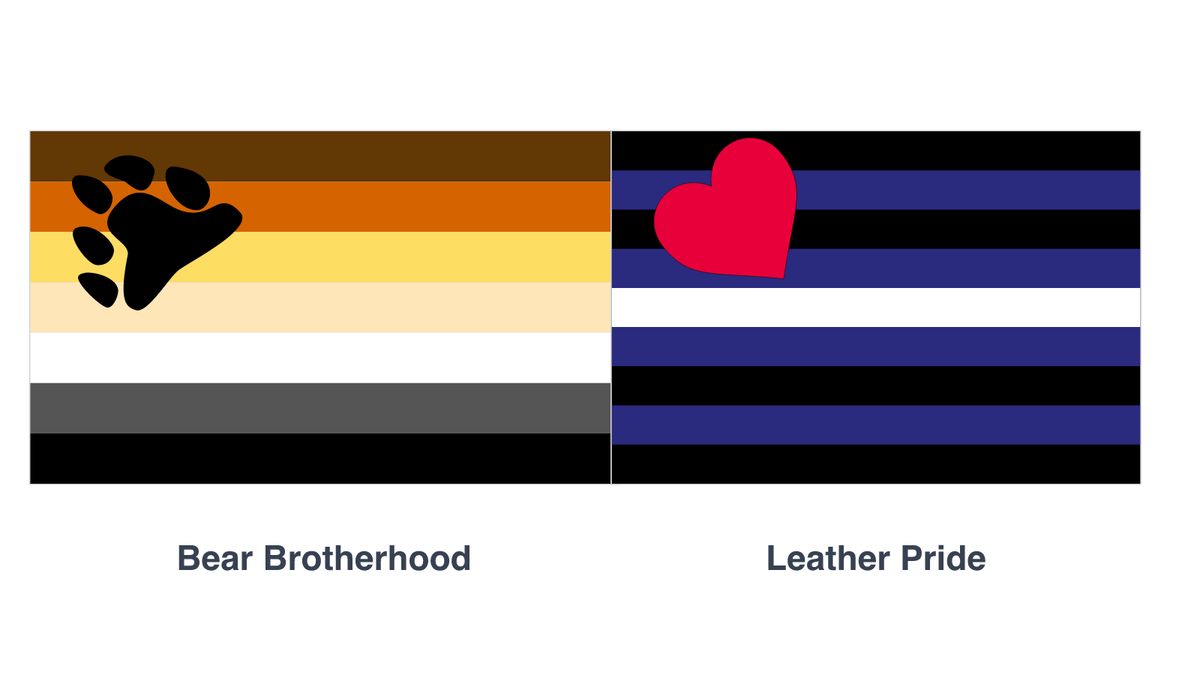
Seven stripes — dark brown, rust, golden yellow, tan, white, grey and black — with a black bear paw print in the upper left corner. The colors represent the fur colors of bear species around the world, which is the detail almost everyone gets wrong: they're about bears, the animals, not about skin tone or ethnicity.
You'll see the Leather Pride flag in the same rooms — black and blue stripes with a white bar and a red heart in the corner, designed by Tony DeBlase and unveiled at International Mr. Leather in Chicago in 1989.
Every other flag you'll see at Pride
A quick index of the flags that show up in real crowds, with the detail that makes each one identifiable at a glance.
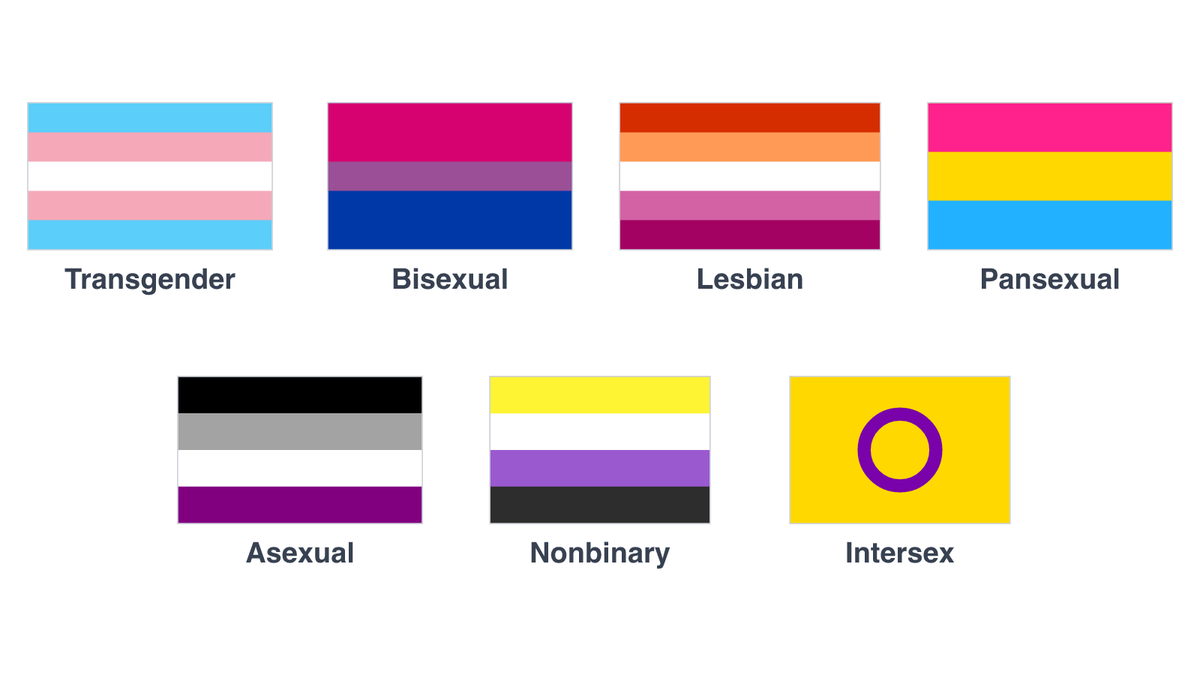
- Transgender. Light blue, pink, white, pink, light blue. Monica Helms designed it in 1999 and it first flew at a Phoenix pride parade in 2000. It's symmetrical on purpose — there is no upside down, which Helms intended as the point. She donated the original to the Smithsonian's National Museum of American History in August 2014.
- Bisexual. A wide magenta band, a thin lavender band, a wide blue band. Michael Page designed it in 1998. Magenta is same-gender attraction, blue is different-gender attraction, and the lavender is where the two blend — deliberately, so it has no hard edge.
- Lesbian. Five stripes running orange to pink, often called the sunset flag. Emily Gwen posted a seven-stripe version to Tumblr in 2018 — gender nonconformity, independence, community, unique relationships to womanhood, serenity and peace, love and sex, femininity — and the community trimmed it to five and adopted it without anyone declaring it official. Older designs exist, including a 1999 labrys flag and a 2010 "lipstick" version now largely out of use.
- Pansexual. Three thick bands: pink, yellow, blue. Pink for attraction to women, blue for men, yellow for nonbinary people and everyone else. It surfaced online around 2010, generally credited to a designer known as Jasper V.
- Asexual. Black, grey, white, purple. Black for asexuality, grey for grey-asexual and demisexual identities, white for allies and partners, purple for the community. It came out of a 2010 vote on the AVEN forums — hence the purple, matching that site.
- Nonbinary. Yellow, white, purple, black. Kye Rowan designed it in 2014 — yellow for genders outside the binary, white for many or all genders, purple for a mix of masculine and feminine, black for agender. Rowan made it to sit alongside the earlier genderqueer flag, not to replace it.
- Intersex. A purple circle on a yellow field. Morgan Carpenter designed it in 2013 at the Australian intersex advocacy organization now called InterAction for Health and Human Rights, choosing yellow and purple precisely because neither carries gender baggage. The circle is unbroken and unornamented — wholeness, and the right to bodily autonomy.
Pro Tip
Best place to learn these fast: the flag vendors at a large Pride festival. They stock dozens of designs and will happily tell you what each one is — twenty minutes at a merch tent beats an hour of scrolling.
Where you'll actually see them
Flags read differently in person — scale, wind and a crowd do most of the work.
- Pride weekends. Our Pride Weekend Calendar has every major US date, so you can pick one that fits your travel window rather than defaulting to June.
- The big parades. Chicago Pride and NYC Pride both run contingents organized by identity — the clearest place to see the full range in one afternoon. Atlanta Pride does the same in October, if summer heat isn't your thing.
- The week around it. Flags go up well before the parade and the bar events start earlier still — check what's on in Chicago, New York or San Francisco for the days on either side.
- The neighborhoods, year-round. Rainbow crosswalks, permanent flagpoles and bar awnings don't come down in July. Our guide to the best gayborhoods in America covers 22 of them.
Pride weekends in 100+ cities
Parades, block parties, bar takeovers and everything around them — live on Out x Out.
Frequently asked questions about Pride flags
Who designed the Pride flag?
Gilbert Baker, a San Francisco artist and drag performer who taught himself to sew. The first two flags flew at the city's Gay Freedom Day Parade on June 25, 1978. He never trademarked the design, and MoMA added it to its design collection in 2015. Baker died in March 2017.
Why was the pink stripe removed from the Pride flag?
Because the fabric wasn't available. Demand jumped after Harvey Milk's assassination in November 1978, and hot pink couldn't be sourced for mass production at that scale. It came off for supply reasons, not political ones. Hot pink stood for sex in the original design.
Why did the flag go from eight stripes to six?
Two separate cuts, about a year apart. Hot pink went first in late 1978, for the fabric shortage above. Turquoise went next, in 1979, when the flag was hung down Market Street split evenly on both sides of the lampposts — seven stripes don't divide in half, six do. With turquoise gone, the original indigo stripe became the royal blue on today's flag.
Do I need to replace my rainbow flag with a Progress flag?
No. The six-stripe rainbow remains the default LGBTQ+ symbol worldwide and it is what most Pride organizations, bars and cities still fly. Newer flags add emphasis; they don't retire the rainbow. The eight-stripe 1978 original is equally fine to fly.
What do the six colors of the Pride flag mean?
Red is life, orange is healing, yellow is sunlight, green is nature, blue is serenity, and violet is spirit. Baker assigned each meaning himself. The original 1978 flag also had hot pink for sex and turquoise for magic and art.
What's the difference between the rainbow flag and the Progress Pride flag?
The Progress flag is the six-stripe rainbow plus a chevron on the left edge: black and brown for LGBTQ+ people of color, and light blue, pink and white from the transgender flag. Daniel Quasar designed it in 2018, with the chevron pointing right to signal that inclusion is still in progress. An intersex-inclusive version by Valentino Vecchietti (2021) adds a purple circle on a yellow triangle.
What does the Bear Brotherhood flag mean?
Craig Byrnes designed it in 1995. Its seven stripes — dark brown, rust, golden yellow, tan, white, grey and black — represent the fur colors of bear species around the world, with a black paw print in the upper left corner. The colors refer to the animals, not to human skin tone.
Is there one official Pride flag?
No. There's no governing body that certifies Pride flags, and none of the major designs were ever ratified by anyone — the six-stripe rainbow, the Progress flag and the lesbian sunset flag all spread by adoption rather than decree. That's why several versions coexist.
More guides
- Pride Weekend Calendar 2026–2027 — every major US Pride date in one place.
- The Best Gayborhoods in America — 22 neighborhoods where the flags stay up all year.
- The Most Gay-Friendly Cities in the US — where to point the next trip.
- Provincetown Bear Week — the paw-print flag in its natural habitat.
Flag artwork via Wikimedia Commons, public domain except the Bear Brotherhood flag (by Fibonacci, [CC BY-SA 3.0](https://creativecommons.org/licenses/by-sa/3.0/)).
Enjoyed this article?
Subscribe to our newsletter for more LGBTQ+ travel guides, local discoveries, and community stories delivered to your inbox.
Subscribe to Newsletter
Robbie S.
I'm Robbie, the founder of Out x Out. I'm from Minneapolis, though I'm spending 2026 building this community from the road — somewhere between South America and Asia. The idea for Out x Out came from a trip to Berlin, where the gay nightlife calendar was years ahead of ours: you could see not just where to go out, but which night to go — so naturally I wanted that kind of insider info for every city in the US (and beyond... eventually). I'm more of a behind-the-scenes type, but the whole point of this is connection: I'd take one real one over a hundred surface-level ones, and I'm trying to build that for the community, city by city.
Related Posts
Your First Drag Show: What to Wear, How Much Cash to Bring, and Tipping Etiquette
The practical first-timer's guide to drag: what people actually wear, how much cash to bring, how to hand a tip to a queen without making it weird, and what the room expects of you.
First Time at a Gay Bar: What to Expect (and Why You Should Go)
A gay bar is a bar. Here's what actually happens on a normal night, why walking in alone is easier than you think, and how to pick the right one for your first time.
Gay Bathhouse 101: What to Expect and the Etiquette Nobody Tells You
A calm, practical answer to every question first-timers actually have about gay bathhouses — how check-in works, the unwritten rules, what things cost, and why almost everyone there came alone.