
What Is a Drag Queen? History, the Craft, and Every Question You've Wondered About

Drag is an art form, not an identity, and what people assume about it is off. Here's what a drag queen actually is, where drag came from, what the job pays, and how the illusion gets built.
Get LGBTQ+ Travel Tips in Your Inbox
Join our newsletter for exclusive travel guides, local insights, and community updates. No spam, unsubscribe anytime.
Subscribe NowMost people meet drag before they understand it. A queen hosts a bingo night, a friend's brunch comes with a show, a clip lands on your feed, and you walk away entertained but holding a pile of half-formed questions you'd feel silly asking out loud.
So: what are drag queens, really? Here's the whole thing answered plainly. What a drag queen is, how drag relates to being transgender (not the same thing), who's allowed to do it, where it came from, what it pays, and how the wigs, brows, and body get built.
The short answer
- What it is: drag is a performance art. A person of any gender performs an exaggerated, theatrical version of femininity for an audience.
- It is not an identity. Drag is something you do. Being transgender is who someone is. Some performers are both; most are not.
- Who can be one: anyone. Cis men, cis women, trans women, trans men, nonbinary people, and straight men all do it professionally today.
- How old it is: American drag balls date to at least the 1880s, and the first known American to call himself a "queen of drag" was born into slavery.
- What it pays: commonly $50–$250 a night plus tips at bar and club gigs, with only a minority of performers earning a full-time living from it.
- Why they lip sync: it started as a practical bar-performance format in the mid-1900s and became the discipline the art is judged on.
What is a drag queen?
The direct answer: a drag queen is a performer who creates and plays an exaggerated feminine character on stage, through makeup, costume, wigs, movement, comedy, and usually lip sync. The character is the point, and it's closer to clowning or cabaret than to anything about the performer's private life.
The role has always been about heightening rather than imitating. A drag queen isn't trying to be mistaken for a woman on the street. She's building a character two sizes larger than life so it reads from the back of a dark bar. Two things follow from that.
- Drag is a job. The queen hosting your brunch is a working performer with a set list and a mortgage, and pageant drag, comedy drag, club-kid drag, and horror drag look nothing alike.
- The character has a name, and it isn't the performer's. Use her drag name and the pronouns she uses in drag, usually she/her in character. It's a courtesy, not a statement about anything else.
Drag vs. being transgender: the difference that matters
Drag is a performance. Being transgender is a gender identity. They're separate things that occasionally overlap in the same person, the way an actor can also be Catholic.
- A drag queen puts on a character to perform, then takes it off. The vast majority are cisgender men who go back to their own name and clothes on Monday.
- A transgender person's gender is not a costume, a performance, or something that ends when the show does.
- Both can be true at once. Plenty of trans women perform in drag, and drag has long been one of very few paying stages open to trans performers. That's an overlap, not an equivalence.
The practical version: don't ask a performer which one they are, and don't assume. A performer's gender is theirs to state, and many do state it publicly. That's the only source worth working from.
Who can be a drag queen: women, trans women, and straight men
The internet asks this constantly, usually as three separate questions, and the answer to all three is yes. It isn't a technicality either. It's a list of names.
- Cisgender women. Performers assigned female at birth are sometimes called AFAB queens; the older terms "bio queen" and "faux queen" are falling out of use. In 2023, Germany's Pandora Nox became the first cis woman to win a Drag Race crown anywhere in the franchise, and Clover Bish competed on Drag Race España before her. The first to compete anywhere was Victoria Scone on the UK's third series in 2021, who has since come out as nonbinary and uses they/them.
- Trans women. Peppermint competed on season 9 as an out trans woman in 2017. Kylie Sonique Love won All Stars 6 in 2021, the first trans winner of a US season. Sasha Colby won season 15 in 2023, out as trans throughout.
- Trans men. Gottmik competed on season 13 in 2021 as the first out trans man on the US show. A trans man performing as a drag queen is exactly what makes the "drag equals identity" assumption fall apart.
- Straight men. Maddy Morphosis joined season 14 in 2022 as the first openly straight cisgender man to compete. The casting caused a real argument inside the community about who drag belongs to, but the answer to "can a straight man be a drag queen" has been yes for as long as drag has existed.
Pro Tip
There are drag kings too, performers doing exaggerated masculinity, and the tradition is just as old. Stormé DeLarverie spent fourteen years as the MC and sole male impersonator of the Jewel Box Revue, America's first racially integrated touring drag show, which ran for more than three decades and regularly played the Apollo.
A short history of drag: balls, Stonewall, and Drag Race
Drag did not start with a TV show. It starts, in America, with a formerly enslaved man throwing parties the police kept raiding.
The balls (1880s–1930s)
William Dorsey Swann, born into slavery in Maryland, hosted private drag balls in Washington, D.C., in the 1880s, and is the first known American to describe himself as a "queen of drag." He was arrested repeatedly, and at one raid he fought the police in a satin gown. His story sat unrecovered until historian Channing Gerard Joseph pieced it together from newspaper archives; Smithsonian tells the accessible version.
By the 1920s, Harlem's Hamilton Lodge Ball had turned the form into a citywide spectacle, drawing thousands of dancers and spectators through the Harlem Renaissance before its final ball in 1937.
The houses (1960s–1990)
In 1967, Crystal LaBeija walked out of the Miss All-America Camp Beauty Pageant on camera, accusing the organizers of rigging the result toward a white contestant. The moment is preserved in the 1968 documentary The Queen. Rather than keep competing in white-run pageants, she and Lottie LaBeija staged their own: the first House of LaBeija Ball, in Harlem, in 1972. That's the origin of the "house" system of chosen families with mothers, fathers, and children, which still organizes ballroom today. Jennie Livingston's 1990 documentary Paris Is Burning brought that world, and much of the vocabulary now in mainstream use, to a national audience.
Stonewall and the riot years
Drag performers were not bystanders in the movement. The 1966 Compton's Cafeteria uprising in San Francisco and the 1969 Stonewall uprising in New York both began in bars where drag queens and trans women were routine targets of police raids. Marsha P. Johnson and Sylvia Rivera, fixtures of that scene, co-founded STAR (Street Transvestite Action Revolutionaries) in 1970 to house young people the movement wasn't feeding. Who did what in Stonewall's first minutes is still disputed by historians. That drag performers were there, and organizing afterward, is not.
The mainstreaming (2009–now)
RuPaul's Drag Race premiered on Logo on February 2, 2009, moved to VH1 in 2017 and MTV in 2023, and turned a bar art form into a global television format. It won the Emmy for Outstanding Reality-Competition Program four years running from 2018 to 2021, RuPaul won Outstanding Host eight consecutive years from 2016 to 2023, and franchises now run in more than a dozen countries.
The effect on the ground is the part that matters to you. Drag went from something you had to know a bar to find, to something with a ticket link and a brunch reservation. Our guides to drag in Chicago, New York, and Los Angeles exist because there's now more of it running on a Tuesday than most cities used to have in a month. There's even enough of a viewing-party circuit to warrant a guide to watching Drag Race out in Chicago.
Do drag queens get paid? What the job actually earns
Yes, but less than the production values suggest. Performers get a booking fee from the venue plus whatever the room tips, and at smaller shows the tips are frequently the larger half. Honest ranges, from performers talking on the record:
- A local bar or club gig: roughly $75–$200 per booking, per a 2025 Salon report on drag economics. Vice puts New York bar rates at $50–$250 a night plus tips, and QNotes found Charlotte queens closer to $50–$100. A brand-new performer is often at the bottom of that.
- Tips: QNotes puts a local queen's take at $30–$100 a night depending on the room and the number. On a $75 booking fee, that's a $105–$175 night before costs.
- Private events and corporate bookings: up to $800 a night, per Vice. This is where performers who treat drag as a business make their margin.
- A *Drag Race* alum: QNotes puts televised queens at $1,500–$3,000 as a booking fee plus $500 or more in tips. Vice's reporting on life after the show tracks the jump directly: contestants describe going from $125–$250 a gig beforehand to $800–$1,500 booking fees soon after airing, climbing from there with popularity, and one UK alum puts her annual take at a quarter of a million. That's a different profession from the one above it.
Then the costs, which are the part nobody sees:
- Wigs: $20 for a basic synthetic to $700 for a styled lace front, plus $50–$200 every time one needs restyling.
- Everything else: commissioned looks from $200 up, a makeup kit at $50–$100 replaced every couple of months, padding, tights, size-13 heels from $75, travel, and three to four unpaid hours getting ready for a show that pays $150. One performer interviewed by Vice put her own annual drag spending near $10,000; QNotes priced a single four-look performance at roughly $650 to assemble.
Salon's reporting puts full-time earners at roughly a quarter of performers, with most breaking about even. A headliner can clear six figures. The queen at your neighborhood bar is likely subsidizing her own costumes with a day job. That's the whole argument for tipping well, which we cover properly in our first drag show guide.
Pro Tip
At free bar shows in particular, the venue's fee may be nominal or nonexistent, which makes the room's cash the actual wage. Bring singles, and tip the host too, not just the headliner you liked best.
The craft: how the illusion gets built
A full face and body takes most performers two to four hours. Here's what happens in those hours, without the mystique.
- Brow blocking. The natural eyebrows get flattened and hidden so a higher, more dramatic brow can be drawn on a blank canvas, which also frees up enormous real estate for eye makeup. Professionals use Pros-Aide or spirit gum. The industry-standard cheap version is a plain Elmer's glue stick from the school-supply aisle, layered over brow hairs combed flat with a spoolie or a spoon, then sealed with powder and concealer. Same glue stick your third-grade teacher bought, and it works.
- Head and face taping. Tape is anchored at the temples and hairline, pulled up and back, and secured under the wig cap at the back of the skull. It's a temporary, non-surgical lift that raises the brows and sharpens the cheekbones for the length of a show. Medical-grade tape is the standard because the skin there is thin, performers wipe the area with alcohol first so it holds, and the wig hides all of the hardware.
- Tucking. Flattening the front silhouette, with the anatomy drawn back and secured by tape or by a gaff, a purpose-built compression garment. Gaffs have largely replaced tape for anyone performing regularly, since tape is single-use and rough on skin over time. Performers treat tucking as time-limited rather than all-day and take breaks during long gigs. It's uncomfortable, it's a skill, and it's the least glamorous part of the job.
- Padding and wigs. Foam hip and rear padding under several layers of tights builds the silhouette the costume is cut for, though plenty of styles skip padding entirely. Wigs get stacked several to a look for height. A styled lace front is the most expensive item in most kits, and the thing you should never touch.
Pro Tip
Two hard rules if a performer is at your table: don't touch the wig, don't touch the performer. All of the above is engineered, expensive, and load-bearing, and consent in a drag room runs one direction only.
Drag slang, decoded
A working mini-glossary for the words you'll actually hear at a show.
- Camp. The sensibility underneath all of this: deliberate excess, artifice enjoyed as artifice, seriousness about things that aren't serious. Susan Sontag's 1964 essay "Notes on 'Camp'" is the standard reference, and the Met made it a gala theme in 2019. A queen doing something enormous and slightly ridiculous entirely on purpose is camp.
- Lip sync. Performing a recorded song by mouthing it, in character, with choreography. Not a shortcut, and the discipline the whole art is judged on.
- Mary. A term of address between gay men, affectionate or exasperated or teasing depending entirely on delivery. "Mary, no." It predates most of this vocabulary by decades.
- Fish / fishy. Drag that reads as conventionally, unmistakably feminine. Usually deployed as a compliment, and also contested. Plenty of performers avoid it, because grading drag on how closely it resembles a cis woman misses that drag isn't an impersonation contest.
- Booger. The opposite of fishy: sloppy, unpolished drag from a performer who can't paint, style, or sew. An insult, usually delivered with a smile, and occasionally reclaimed on purpose by performers doing deliberately ugly or horror-leaning drag.
- House. A chosen family in ballroom culture, with a mother, a father, and children who take the house name. The LaBeijas, the Xtravaganzas. Still active, and older than any television show about it.
Why lip syncing is the standard
Because it started as the practical way to perform in a bar, and then became the art form's core discipline.
The origin is technological and economic. As affordable record players and jukeboxes spread through mid-century bars, performers began bringing their own records in and miming along. Anthropologist Esther Newton documented the practice in Mother Camp, her landmark 1972 study of drag. These "record acts" paid less than live singing or comedy but needed no band, no sound engineer, and no formal training, which made them the entry point for performers who had few other ways to earn.
The cheap option turned out to be the expressive one. Lip sync lets a performer inhabit a voice, whether that's Whitney, Cher, or a Broadway belt, and use the audience's existing relationship with that song as raw material. Drag Race then formalized it. "Lip Sync for Your Life" made it the elimination mechanism, and a generation trained on it as an athletic, technically demanding form. Live singing never went away, and comedy queens barely lip sync at all, but go to one show and you'll see it. If it's a good one, you'll understand why nobody's replaced it.
"A Drag Queen Christmas," the touring holiday show
It's the national holiday drag tour, produced by Murray & Peter, playing theaters across the country every November and December and billed by its producers as America's longest-running drag tour.
The 2026 edition is hosted by Drag Race alum and theater performer Nina West, with a lineup drawn from the franchise. It's a theatrical show rather than a bar show: Broadway-scale staging, elaborate costumes, high camp, comedy, and lip sync, running roughly two hours with an intermission, and most stops sell a VIP meet-and-greet add-on. It's generally billed as an 18+ show, and some venues bar under-18s outright, so check your specific theater before bringing anyone younger. Buy early too, because the tour hits each city exactly once.
Pro Tip
It isn't the only holiday drag on the calendar. Nearly every city with a scene runs its own Christmas shows, holiday brunches, and charity bingo nights through December, and those are cheaper, closer, and often better for a group than a theater ticket. Check the [Chicago](https://outxout.com/events/chicago-il), [New York](https://outxout.com/events/new-york-city-ny), and [Los Angeles](https://outxout.com/events/los-angeles-ca) calendars in late November.
Where to see drag for yourself
Reading about drag is a poor substitute for a dark room, a working queen, and twenty singles. The easiest entry points:
- Your first drag show: what to wear, cash, and tipping — the practical companion to this piece.
- Drag brunch across the US — the gentlest first show, with daylight, chairs, and a hard end time.
- Drag shows in Chicago and New York — the two deepest benches in the country, sorted by night of the week.
- Drag shows in Las Vegas — the easiest city to see three shows in one weekend.
- Provincetown drag — the densest drag town in America for its size, June through September.
Or skip the roundups and check what's on tonight: live listings for Chicago, New York, Los Angeles, and Las Vegas update daily.
Find a drag show near you
Drag shows, brunches, and bingo nights. Live listings in 100+ cities on Out x Out.
Frequently asked questions about drag queens
What are drag queens?
Performers who create exaggerated feminine characters, through makeup, wigs, costume, and usually lip sync, and perform them for an audience. Drag is a theatrical art form, closer to cabaret or clowning than to anything about a performer's own gender or sexuality. Drag queens work bars, clubs, brunches, bingo nights, theaters, and touring shows.
Are drag queens transgender?
Usually not. Drag is a performance; being transgender is a gender identity. Most drag queens are cisgender men who take the character off after the show. Some drag performers are trans, and drag has long been one of the few paying stages open to trans performers, but the two are separate things and a performer's gender is theirs to state.
Are drag queens always men?
No. Cisgender women, trans women, trans men, and nonbinary people all perform as drag queens. Victoria Scone was the first cis woman to compete on a Drag Race franchise, in 2021; Germany's Pandora Nox became the first cis woman to win a Drag Race crown in 2023; Gottmik competed in 2021 as the first out trans man on the US show.
Can drag queens be straight men?
Yes. Straight men have performed in drag for as long as drag has existed, and Maddy Morphosis competed on RuPaul's Drag Race season 14 in 2022 as the first openly straight cisgender man on the show. The casting sparked a genuine debate inside the community about who the art form belongs to, but the answer to the question is yes.
Do drag queens get paid?
Yes, through a booking fee from the venue plus tips from the room. Bar and club gigs commonly pay $50–$200, New York bar rates run to $250 a night, private events reach $800, and Drag Race alumni report booking fees from $800–$1,500 soon after airing up to $1,500–$3,000 once established. Tips add roughly $30–$100 a night at a local show and, at free shows, are effectively the entire wage.
What is the average salary of a drag queen?
There's no reliable national average, because almost nobody does it as a single salaried job. Salon's reporting suggests roughly a quarter of performers earn a full-time income from drag and most break about even after expenses, with wigs, costumes, makeup, and travel eating the difference. A touring headliner can clear six figures; the queen at your local bar likely has a day job.
How do drag queens tuck?
By flattening the front silhouette using either tape or a gaff, a purpose-built compression garment. Gaffs have largely replaced tape for regular performers, since tape is single-use and hard on skin. Performers treat tucking as time-limited rather than all-day, and take breaks during long shows.
Why do drag queens tape their heads?
To lift the face. Tape is anchored at the temples and hairline, pulled up and back, and secured under the wig cap, producing a temporary, non-surgical lift that raises the brows and sharpens the cheekbones for the length of a show. Medical-grade tape is standard because the skin there is thin, and the wig covers the tape entirely.
Why do drag queens use glue sticks on their eyebrows?
To block the brows. A plain school glue stick, usually Elmer's, is layered over eyebrow hairs combed flat, then sealed with powder and concealer so the natural brow disappears. That gives a blank canvas for drawing a higher, more dramatic brow and frees up space for eye makeup. Professional alternatives like Pros-Aide and spirit gum exist; the glue stick is cheaper and works.
Why do drag queens lip sync?
It began as the practical way to perform in mid-century bars, once jukeboxes and cheap record players meant a performer could bring in their own record and mime along, with no band, no training, and no sound engineer required. Anthropologist Esther Newton documented these "record acts" in Mother Camp in 1972. RuPaul's Drag Race later made "Lip Sync for Your Life" the elimination format, turning it into the technical discipline the art is judged on.
What does "fish" mean in drag?
Drag that reads as conventionally, unmistakably feminine. It's generally meant as a compliment, and it's also a contested term. Many performers avoid it, on the grounds that judging drag by how closely it resembles a cisgender woman misunderstands what drag is doing.
What does "booger" mean in drag?
The opposite of fishy: sloppy, unpolished drag from a performer who can't paint, style, or sew. It's an insult, usually delivered affectionately, and some performers reclaim it on purpose for deliberately ugly or horror-leaning drag.
Why do drag queens say "Mary"?
It's a long-standing term of address between gay men, used with affection, familiarity, or mild exasperation depending entirely on delivery. It predates most modern drag slang and is one of the oldest pieces of the vocabulary still in daily use.
What does "camp" mean in drag?
Deliberate excess: artifice enjoyed as artifice, taking unserious things seriously and serious things lightly. Susan Sontag's 1964 essay "Notes on 'Camp'" is the standard reference point, and the Met Gala took it as a theme in 2019. In a drag room, camp is the enormous, knowingly ridiculous choice made entirely on purpose.
What is "A Drag Queen Christmas"?
A national holiday drag tour produced by Murray & Peter, running every November and December and billed by its producers as America's longest-running drag tour. The 2026 edition is hosted by Nina West with a lineup of Drag Race alumni. It's a two-hour theater show, generally billed 18+, with a VIP meet-and-greet add-on at most stops.
Who was the first drag queen?
The first known American to call himself a "queen of drag" was William Dorsey Swann, who was born into slavery and hosted drag balls in Washington, D.C., in the 1880s. He was arrested repeatedly in police raids and, in one, fought officers while wearing a satin gown. His story was largely lost until historian Channing Gerard Joseph reconstructed it from newspaper archives.
More drag guides
Enjoyed this article?
Subscribe to our newsletter for more LGBTQ+ travel guides, local discoveries, and community stories delivered to your inbox.
Subscribe to Newsletter
Robbie S.
I'm Robbie, the founder of Out x Out. I'm from Minneapolis, though I'm spending 2026 building this community from the road — somewhere between South America and Asia. The idea for Out x Out came from a trip to Berlin, where the gay nightlife calendar was years ahead of ours: you could see not just where to go out, but which night to go — so naturally I wanted that kind of insider info for every city in the US (and beyond... eventually). I'm more of a behind-the-scenes type, but the whole point of this is connection: I'd take one real one over a hundred surface-level ones, and I'm trying to build that for the community, city by city.
Related Posts
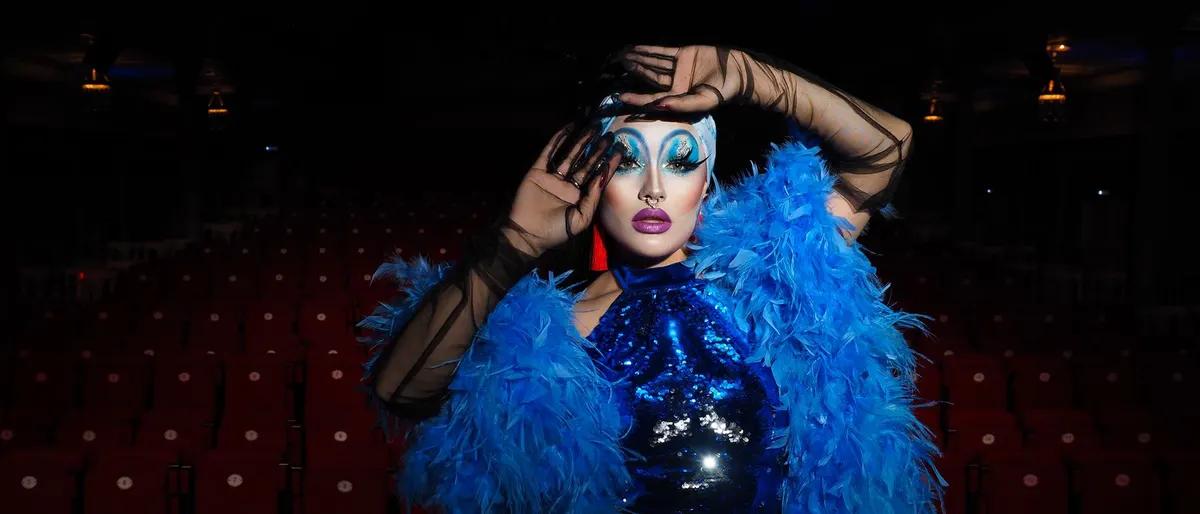
Your First Drag Show: What to Wear, How Much Cash to Bring, and Tipping Etiquette
The practical first-timer's guide to drag: what people actually wear, how much cash to bring, how to hand a tip to a queen without making it weird, and what the room expects of you.

First Time at a Gay Bar: What to Expect (and Why You Should Go)
A gay bar is a bar. Here's what actually happens on a normal night, why walking in alone is easier than you think, and how to pick the right one for your first time.

Gay Bathhouse 101: What to Expect and the Etiquette Nobody Tells You
A calm, practical answer to every question first-timers actually have about gay bathhouses — how check-in works, the unwritten rules, what things cost, and why almost everyone there came alone.