
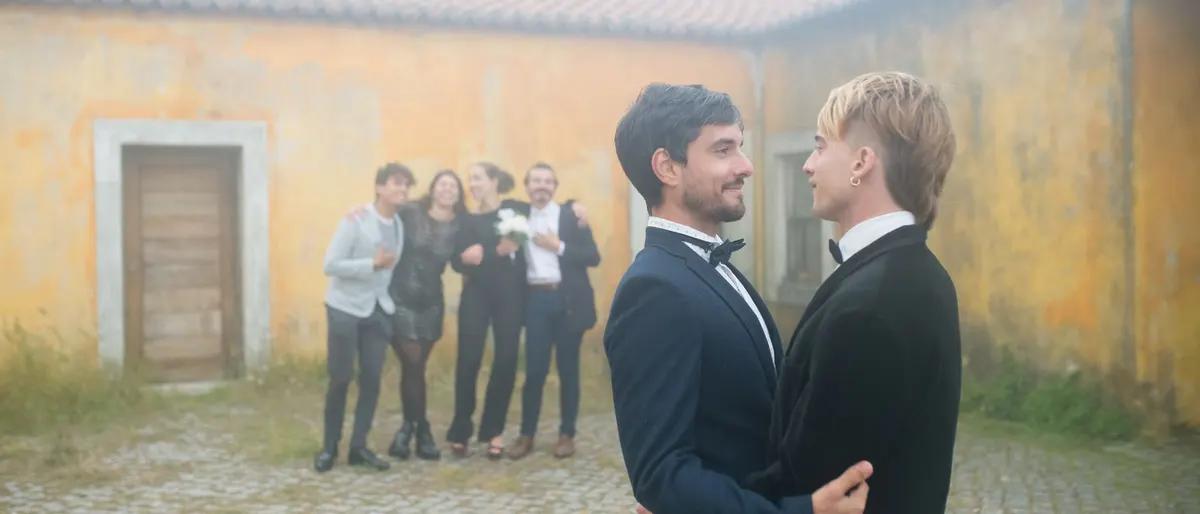
How Gay Weddings Work: What to Expect, Who Walks, Who Pays, Rings and Names

There is no rulebook for a wedding with two grooms or two brides, which is the point. Here is what couples actually do, from the aisle to the rings to the last name, with the survey data behind it, plus what to expect if you are a guest.
Get LGBTQ+ Travel Tips in Your Inbox
Join our newsletter for exclusive travel guides, local insights, and community updates. No spam, unsubscribe anytime.
Subscribe NowA gay wedding works like any other wedding, with one difference: the traditions built around a bride and a groom do not assign themselves, so the couple decides who walks, who proposes, who pays and whose name goes where. Many couples borrow the traditions they like and rewrite the rest. This guide covers the conventions couples actually use, with the survey data behind them where it exists, and what to expect if you are going as a guest.
Same-sex marriage has been legal in every US state since the Supreme Court's Obergefell v. Hodges ruling in June 2015, and in November 2025 the Court declined to revisit it. The US Census Bureau estimated roughly 836,000 married same-sex couple households in 2024, up from about 392,000 in 2005.
The Short Answer
- Who walks down the aisle: both, together, separately, escorted by family, or from two sides at once. There is no default.
- Who proposes: either partner, and sometimes both. In The Knot's 2017 LGBTQ+ weddings study, 17 percent of female couples and 11 percent of male couples both proposed to each other.
- Who pays: mostly the couple, with family help where it is offered.
- Rings: some couples both wear engagement rings, and most wear wedding bands on the left hand, according to the jeweler Brilliance.
- Last names: keep, hyphenate, take one partner's, or make a new one.
- What it costs: the Williams Institute puts average spending by couples who married after Obergefell at $8,546. The studies on wedding costs measure different things, so see the cost section before you budget.
Who Walks Down the Aisle
The processional is one of the first traditions couples rewrite. A planner quoted by The Knot says couples can each be escorted by parents or other significant people, enter individually, or process together.
- Together: in The Knot's 2017 study, 42 percent of male couples and 20 percent of female couples walked in side by side to mark the start of their journey together.
- One after the other: each partner walks alone or with an escort, in whatever order the couple likes.
- From two sides: Wed Society describes partners proceeding toward each other from separate points and meeting at the altar at the same moment.
- Escorted together: one person who matters to both of you walks you both down, one on each arm.
- Rethink the aisle: some couples hold the ceremony in the round, use more than one aisle or skip the processional completely, options The Knot's 2017 study mentions.
Pro Tip
If you cannot decide, walk in together. It solves the order question, the escort question and the who-waits-at-the-front question at once.
Proposals and Engagement Rings
Who proposes is open to either partner, and sometimes both propose. In The Knot's 2017 study, women were more likely than men to exchange engagement rings at the proposal, 86 percent against 60 percent.
For wedding bands, most couples wear them on the left ring finger, the same as anyone else, according to the jeweler Brilliance, though some choose the right hand. There is no rule, and nobody at the reception will check.
Who Pays
The old convention that the bride's family pays does not map onto two brides or two grooms, and in practice most couples pay for their own weddings. The Williams Institute's 2025 study of couples who married after Obergefell found the money came "primarily from the couples themselves," with some families contributing. In The Knot's 2016 LGBTQ+ study, seven in ten couples said they paid for most of their ceremony, with growing help from family.
If both families want to contribute, the cleanest approach is to let each one fund something specific, such as the rehearsal dinner or the bar, rather than splitting a total.
What a Gay Wedding Costs
The Williams Institute's 2025 study gives the newest figure we found: couples who married after Obergefell spent an average of $8,546, with some spending as much as $65,000. The Knot's LGBTQ+ studies swung widely: $33,822 for male couples and $25,334 for female couples in 2016, then $18,049 and $17,341 in 2017. The Knot's 2026 Real Weddings Study, a survey of 10,474 couples married in 2025, puts the average for all couples at $34,200.
These studies measure different things, from celebrations of any size to full weddings, and are not directly comparable. The Knot names location and guest count as the biggest drivers of wedding cost.
Last Names
Couples have four options: keep both names, hyphenate, have one partner take the other's name, or create a new name together. There is little data on what same-sex couples choose. A 2023 Pew Research Center survey had too few people in same-sex marriages to analyze their choices separately. Name-change steps vary by state; start with the office that issued your marriage certificate, then the Social Security Administration.
The Ceremony
Most of a wedding ceremony needs no change at all. The vows, the readings and the ring exchange work for any couple. The parts that usually change are the gendered words.
- The pronouncement: instead of "husband and wife," Heart of NC Weddings suggests "I pronounce you a married couple," "husbands together," "wife and wife" or "partners for life"; one officiant it quotes uses "I pronounce you equal partners joined in marriage."
- Who gives whom away: some couples drop the giving-away entirely, or have both families say a line of support together.
- The presentation: "Please welcome, for the first time, the married couple" works for anyone.
Bachelor and Bachelorette Weekends
Some couples do separate weekends and some do one joint weekend. Our gay bachelor weekend in Las Vegas guide covers the trip, and our Las Vegas LGBTQ+ guide has the bars and shows.
Destination Weddings and Honeymoons
A destination wedding trims the guest list and bundles the venue with lodging. Massachusetts was the first US state to allow same-sex marriage, in 2004, and Provincetown at the tip of Cape Cod is one place to hold one; our Provincetown guide covers the town. Palm Springs and Key West both have gay resorts and guesthouses; ask each property about wedding room blocks. Our guides to gay resorts in Palm Springs, gay resorts in Puerto Vallarta and the best gay resorts in the US work for the wedding block and the honeymoon alike, and our gay cruise comparison covers the honeymoon-at-sea option.
Finding Welcoming Vendors
In The Knot's 2017 study, 30 percent of female couples and 11 percent of male couples said a vendor had turned them away or made them uncomfortable, and 91 percent of male couples and 92 percent of female couples said they were more likely to book a vendor that caters to LGBTQ+ couples.
- Equally Wed: an LGBTQ+ inclusive vendor and venue directory with filters for vendors it has certified as inclusive.
- The Knot and WeddingWire: The Knot Worldwide announced in 2021 that both would add diversity filters, including one for LGBTQ+ owned businesses.
- Read the contract and the website. Language like "bride and groom" on every form is a small signal worth noticing.
What to Expect as a Guest
If you are going to your first gay wedding, it will look almost exactly like every other wedding you have been to. A few things are worth knowing:
- Sides are optional. Some couples drop "bride's side" and "groom's side"; if there are ushers, follow their lead.
- Address the couple as they introduce themselves. If the invitation says "husbands" or "the newlyweds," use that.
- Gifts and dress code work the same. The registry and the invitation are your guide.
- Do not ask which one is the bride or the groom. The jeweler Brilliance calls the related "who's the man and who's the woman?" question an annoying one; skip it.
Plan the bachelor weekend or the honeymoon
Gay bars, resorts and events in Las Vegas, Palm Springs, Provincetown, Key West, Puerto Vallarta and hundreds more cities.
Frequently Asked Questions
How do gay weddings work?
The same way any wedding does: a license, an officiant, vows and a party. The difference is that the couple chooses how to handle the gendered traditions, such as who walks down the aisle, who proposes and what the officiant says at the pronouncement.
Who walks down the aisle in a gay wedding?
Either partner, both together, or both from separate sides at once. In The Knot's 2017 study, 42 percent of male couples and 20 percent of female couples walked in together.
Who pays for a gay wedding?
Mostly the couple. The Williams Institute's 2025 study found wedding spending came primarily from couples themselves, with some family contributions.
Do both partners get engagement rings?
Often. In The Knot's 2017 study, 86 percent of women and 60 percent of men exchanged engagement rings at the proposal, and some couples both proposed.
Which hand do gay couples wear wedding rings on?
Most wear them on the left ring finger, according to the jeweler Brilliance, and some choose the right. There is no rule.
How much does a gay wedding cost?
The Williams Institute's 2025 study puts average spending by couples who married after Obergefell at $8,546. The Knot's 2017 LGBTQ+ study put it at $18,049 for male couples and $17,341 for female couples. The studies use different methods, and The Knot names location and guest count as the main cost drivers.
Do gay couples change their last names?
Some do and some do not. The options are keeping both names, hyphenating, one partner taking the other's name, or creating a new one. There is little national data on which is most common.
What do you call a gay wedding?
A wedding. Marriage between two men or two women has been legal in every US state since 2015.
More Guides
Enjoyed this article?
Subscribe to our newsletter for more LGBTQ+ travel guides, local discoveries, and community stories delivered to your inbox.
Subscribe to Newsletter
Robbie S.
I'm Robbie, the founder of Out x Out. I'm from Minneapolis, though I'm spending 2026 building this community from the road — somewhere between South America and Asia. The idea for Out x Out came from a trip to Berlin, where the gay nightlife calendar was years ahead of ours: you could see not just where to go out, but which night to go — so naturally I wanted that kind of insider info for every city in the US (and beyond... eventually). I'm more of a behind-the-scenes type, but the whole point of this is connection: I'd take one real one over a hundred surface-level ones, and I'm trying to build that for the community, city by city.
Related Posts
Types of Gay Bars Explained: Leather Bars, Bear Bars, Tea Dances, Piano Bars and More
Leather bar, bear bar, video bar, tea dance, piano bar, dive. Every type of gay bar explained: what it is, how it started, what a night looks like, and how to find one near you.

What Is a Circuit Party? A First-Timer's Guide to the Gay Circuit
Circuit parties are the big dance weekends on the gay calendar. Here's what they are, where the name came from, what actually happens, what to wear, and which one to pick first.

Your First Drag Show: What to Wear, How Much Cash to Bring, and Tipping Etiquette
The practical first-timer's guide to drag: what people actually wear, how much cash to bring, how to hand a tip to a queen without making it weird, and what the room expects of you.