
Gay Fire Island
America's Original Gay Paradise — Cherry Grove & The Pines Since the 1930s
Ranked #22 gayest city in the United States
Fire Island earns a 77 — a score that reflects the tension between being one of the most iconic gay destinations on the planet and the practical realities of a tiny, seasonal, car-free barrier island. Cherry Grove is the oldest documented gay and lesbian community in the United States, with LGBTQ+ residents since the 1930s, and the Cherry Grove Community House & Theatre is listed on the National Register of Historic Places (2013) for its role in that history. The nightlife is legendary: The Ice Palace has been hosting drag shows and dance parties since 1970, Pavilion in the Pines is a world-class circuit party venue, Sip·n·Twirl keeps Cherry Grove dancing outdoors every night, and The Blue Whale serves cocktails overlooking the Pines harbor. Where it loses points: everything is seasonal (Memorial Day through Labor Day only), there are no cars allowed on the island, getting there requires a ferry from Long Island, and living costs are astronomical — a seasonal house share runs $6,000-$15,000 per person. Safety and legal protections score perfect 10s thanks to New York's comprehensive LGBTQ+ protections and the fact that these communities are essentially 100% queer spaces where being gay is simply the default.
Fire Island's nightlife is small in numbers but massive in reputation — 4 bars that are each individually famous in gay culture. The scene splits between two distinct communities: Cherry Grove is the older, more diverse, drag-forward neighborhood where The Ice Palace has been the beating heart of gay nightlife since 1970 with nightly drag shows, cabaret, and packed dance floors, while Sip·n·Twirl keeps the outdoor party going with drag performances and DJs under the stars. The energy is campy, welcoming, and multigenerational.
Fire Island Pines is the more upscale, circuit-oriented community. Pavilion is a world-class dance club that hosts major circuit parties like Pines Party and Ascension, drawing thousands of men from NYC and beyond after a major renovation. The Blue Whale at the Pines harbor is the spot for sunset cocktails and people-watching. The nightlife score of 7 reflects the reality that while every single venue is legendary, there are only 4 bars total — and they're all seasonal, operating roughly Memorial Day through Labor Day.
Drag is woven into Fire Island's DNA — this is the island where the Invasion of the Pines was born in 1976 when drag queen Terry Warren was denied entry to a Pines restaurant and responded by ferrying over from Cherry Grove in full drag with a boatload of queens. That protest became the island's most iconic annual tradition. The Ice Palace hosts nightly drag shows throughout the season including cabaret, variety shows, drag bingo, and full-scale productions. Sip·n·Twirl features drag performances multiple nights per week in its outdoor setting.
Drag brunch exists but is more limited — Cherry's On The Bay hosts drag brunches during the season. Notable queens associated with Fire Island include Bella Noche, Ariel Sinclair, Logan Hardcore, and Flipa Flop, plus the historical legacy of pioneers like Terry Warren and Panzi who performed in Cherry Grove as far back as the 1950s. The score reflects that while the drag scene is deeply historic and nightly during summer, the seasonal limitation and small number of venues cap it below year-round cities.
Fire Island packs an extraordinary number of events into its 14-week season. The crown jewel is the Invasion of the Pines on July 4th weekend — roughly 3,000-5,000 people crowd the Pines harbor as drag queens ferry over from Cherry Grove in a joyful, chaotic spectacle that started as a 1976 protest and became the island's signature tradition. Pines Party in mid-July draws 2,000-3,000 for a flagship circuit party weekend benefiting local nonprofits, and Ascension in August brings another 1,500-2,500 for a similar circuit weekend at Pavilion.
Beyond the big circuit events, the Fire Island Dance Festival (produced by Dancers Responding to AIDS) brings world-class dance performances to the beach in July, Bear Weekend fills Cherry Grove in late June, Women in the Grove events celebrate lesbian and queer women throughout the season, and the Arts Project of Cherry Grove runs a full summer season of theater, cabaret, and film screenings. Memorial Day and Labor Day weekends are major bookend celebrations across all venues. The Pride score of 7 reflects that while there's no formal Pride parade, the Invasion of the Pines functions as the island's Pride equivalent — and honestly, every weekend on Fire Island is effectively a Pride celebration.
Daytime on Fire Island is the main event. The Pines Beach and Cherry Grove Beach are the centers of social life — clothing-optional sections, volleyball, and all-day socializing. Tea dance (late afternoon cocktails and dancing) is a beloved daily ritual at both Sip·n·Twirl and The Blue Whale. Pool parties at private house shares are a constant throughout the season, and the walk through The Meatrack — the wooded trail connecting Cherry Grove to the Pines — is itself a daytime social experience and a living piece of gay history.
Safety & Legal
Fire Island scores perfect 10s on both legal protections and safety. New York State has comprehensive LGBTQ+ nondiscrimination protections in employment, housing, and public accommodations (SONDA 2002, GENDA 2019), marriage equality since 2011, hate crime protections, and a conversion therapy ban for minors since 2019. These are among the strongest state-level protections in the country.
On safety, Cherry Grove and Fire Island Pines are quite possibly the safest LGBTQ+ spaces in America. These communities have been openly, unapologetically gay since the 1940s. There is no "closet" on Fire Island — being queer is the default, not the exception. Anti-LGBTQ+ incidents in the residential communities are virtually unheard of. The isolation of the island (no cars, ferry-only access) creates a natural buffer that has preserved this safety for nearly a century.
Community
Fire Island's community infrastructure is remarkably strong for a place with fewer than 100 year-round residents. The Arts Project of Cherry Grove has been the cultural backbone since 1948 — one of the oldest continuously running LGBTQ+ cultural institutions in the country, producing theater, cabaret, art exhibitions, and community events for over 75 years. SAGE Fire Island provides programming for older LGBTQ+ adults, the Fire Island Pines Historical Preservation Society safeguards the community's extraordinary history, and both the Cherry Grove Community Association and Pines Property Owners Association provide governance.
GMHC (Gay Men's Health Crisis) has deep historical ties to Fire Island from the AIDS crisis of the 1980s, and seasonal pop-up health clinics provide HIV/STI testing during the summer. The community score of 9 reflects that for its tiny size, Fire Island punches absurdly above its weight — these organizations have maintained an unbroken chain of LGBTQ+ community life for nearly a century. The gayborhood score is a perfect 10 because Cherry Grove literally IS the oldest known gay community in America, and the Cherry Grove Community House & Theatre is on the National Register of Historic Places (2013).
Fire Island has no formal LGBTQ+ sports leagues — the island is simply too small and too seasonal to sustain structured leagues. The Pines Gym offers seasonal fitness with group classes including yoga and spin during the summer months, and beach volleyball pickup games happen regularly on both beaches. Charity softball games pop up occasionally as fundraiser events. The primary "sport" on Fire Island is swimming and ocean activities, fitting for a barrier island where the beach is the center of daily life.
The arts scene on Fire Island is anchored by the Arts Project of Cherry Grove, founded in 1948 and one of the oldest continuously running community theaters in the United States. Their summer season includes plays, musicals, cabaret, variety shows, and art exhibitions in their community house. The Fire Island Artist Residency (FIAR), founded in 2011, runs a 4-week summer program for LGBTQ+ visual artists in Cherry Grove. Fire Island Pines hosts gallery shows and architectural house tours celebrating the community's distinctive mid-century modern design. Film screenings during the summer bring LGBTQ+ cinema to the island, and Fire Island itself has been the subject of major cultural works — Hulu's "Fire Island" (2022) starring Joel Kim Booster and Bowen Yang brought renewed mainstream visibility.
Social & Dating
Dating app activity on Fire Island is extremely high during the season — Grindr and Scruff are packed on summer weekends with both residents and visitors from NYC. The grid is full and active from Memorial Day through Labor Day. Off-season, however, activity drops to nearly zero as the island empties out. The score of 7 reflects this split: during its 14-week season, Fire Island rivals any city in the country for app activity, but the seasonal nature means it's not a year-round dating scene.
Social culture on Fire Island is extraordinary — a 10 that's hard to match anywhere else. The house-share tradition (groups of friends renting or owning shares together) means you arrive pre-connected to a social group, and the tiny boardwalk communities make meeting people unavoidable in the best way. Tea dance is a daily social ritual, pool parties happen constantly, and the communal dining culture turns meals into social events. Cherry Grove tends to be more diverse and multigenerational (gay men, lesbians, trans and non-binary people, families), while the Pines skews more toward gay men. Both communities see many of the same visitors returning season after season, creating deep bonds built over decades.
Travel & Cost
Getting to Fire Island requires planning but rewards the effort. From NYC, take the LIRR from Penn Station to Sayville (~90 minutes), taxi to the Sayville Ferry terminal (~5 minutes), then a 30-minute ferry crossing to Cherry Grove or Fire Island Pines (~$20 round trip). Total door-to-door from Manhattan: about 2.5 hours. Water taxis connect the communities once you're on the island. The walkability score of 9 reflects that once you arrive, boardwalks connect everything within each community — it's entirely pedestrian, no cars allowed (1/10 drivability — emergency vehicles only). Transit scores a 3 because you're ferry-dependent with hourly service in peak season and limited late-night runs.
The ferry schedule runs your life on Fire Island — miss the last boat and you're either taking an expensive water taxi or staying the night. Late-night returns from the island can be tricky. But the flip side of this isolation is exactly what has preserved Fire Island's character for a century: no roads, no cars, no chain stores, just boardwalks and beach and a community that has been unapologetically gay since before Stonewall.
Fire Island is a summer destination — everything opens Memorial Day weekend and closes after Labor Day. Peak season is July and August, when circuit parties (Pines Party, Ascension), the Invasion of the Pines, and the Fire Island Dance Festival all happen. June is gorgeous with smaller crowds, and September weekends can be beautiful shoulder-season visits. Off-season (October through April), nearly everything is closed. Hotel prices range from $250-$600/night in season with peak weekends exceeding $800. Cocktails run $16-$22. Budget tip: mid-week visits are significantly cheaper and less crowded than weekends.
Living
Fire Island is not a place most people "live" — fewer than 100 people reside year-round in Cherry Grove and the Pines combined. It's a seasonal resort community, and the costs reflect that. A half-share (every other weekend, Memorial Day through Labor Day) runs $3,000-$8,000 per person for the season. A full share runs $6,000-$15,000+. Renting an entire house for the season costs $30,000-$150,000+ depending on size and location. Buying is even steeper: Cherry Grove cottages start around $500,000 and go to $1.5M, while Pines homes range from $1M to $5M+.
Restaurant costs are resort-level — expect $80-$150 for dinner for two at spots like Island Breeze, Canteen, or Pines Bistro. The living scores of 2 and 1 are not a knock on Fire Island — they simply reflect that this is a luxury seasonal destination, not a city where you'd seek affordable year-round housing. Many Fire Island regulars live in NYC and visit on weekends or for week-long stretches during the summer.
Frequently Asked Questions About Gay Fire Island
Explore More Cities
View All Rankings
Key West
America's Original Gay Paradise — Gay Bars on Duval, Year-Round Sun, Zero Pretense

Orlando
Theme Park Magic Meets Gay Nightlife — Where Gay Days Changed Everything

New York City
The birthplace of Pride and the world's largest gay scene

San Francisco
The city that started it all — 40+ gay bars, the Castro, Folsom, and a scene that never stopped fighting

Chicago
World-class gay scene with what's widely cited as America's first officially recognized gayborhood

Los Angeles
The entertainment capital meets America's gayborhood city — WeHo is a whole municipality built around queer life
Free on iOS & Android
Do More with the App
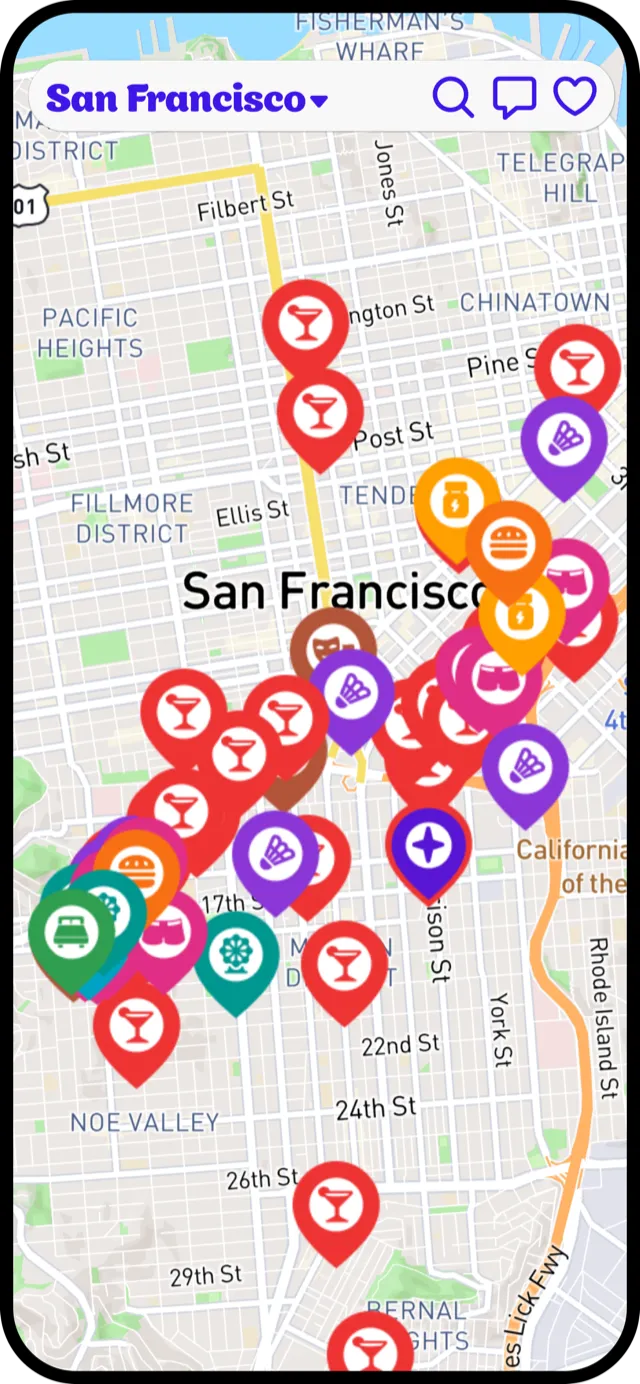
The full Out x Out experience — built for queer nightlife lovers and travelers.
Get the Gay Fire Island Guide
Events, venues, and city guides delivered weekly.
No spam, unsubscribe anytime.